- Home
- Bees, Wasps, Ants
- Bumblebees, Cuckoo bees, Flower bees and Honeybees, etc.
- Apidae - bumblebees, etc.
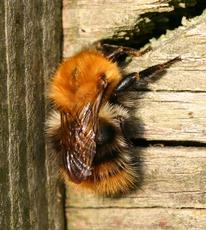
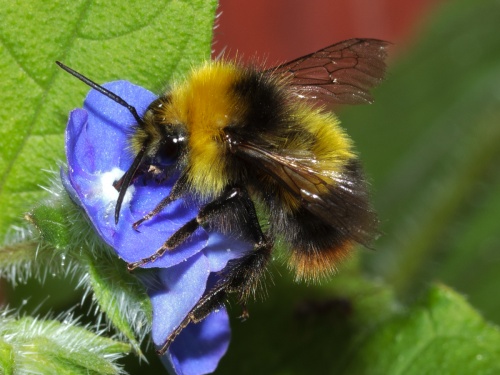
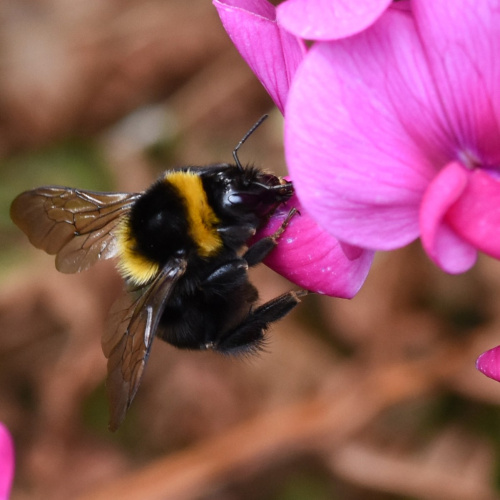
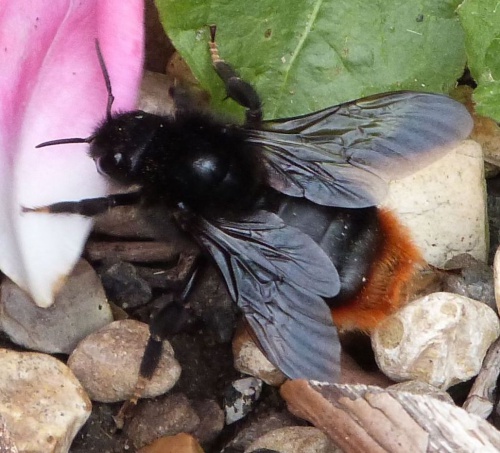
All images on this website have been taken in Leicestershire and Rutland by NatureSpot members. We welcome new contributions - just register and use the Submit Records form to post your photos. Click on any image below to visit the species page. The RED / AMBER / GREEN dots indicate how easy it is to identify the species - see our Identification Difficulty page for more information. A coloured rating followed by an exclamation mark denotes that different ID difficulties apply to either males and females or to the larvae - see the species page for more detail.
Bees, Wasps, Ants
Bees, wasps, ants and sawflies are all part of the insect order Hymenoptera. A typical hymenopteran has 2 pairs of wings which are coupled together with tiny hooks. Bees, wasps and ants are in the sub-Order Apocrita, with a definite waist between the thorax and abdomen.
We have placed Sawflies in a separate gallery because they are in the sub-Order Symphyta, and considered to be more primitive than other groups of the Hymenoptera. They are very different to bees, wasps and ants - one distinctive feature is that they don't have a waist.
We recommend visiting the Bees, Wasps and Ants Recording Society website - it has excellent resources and species descriptions. BWARS Facebook Group is a good source of help with identification. Steven Falk's Flickr albums on Hymenoptera are a fantastic resource of high quality photos, and much more.
Whilst everyone is familiar with the social bumblebees and honeybees, these represent about 10% of all the British bee species. The remainder are solitary bees that don't work together as a single colony to rear their young. There are some very good resources to bees and Steven Falk's Field Guide to Bees of Great Britain and Ireland (Bloomsbury, 2015) is the best place to start; it includes keys to both males and females, and descriptions for all species with notes of habitat, ecology and distribution. Steven Falk's Flickr albums for bees complement his book.
There is an even greater diversity of wasps. As with the bees, there are a few social wasps that everyone is familiar with, but these represent just a small fraction of all UK wasps. Sand-wasps, Digger-wasps, Mason wasps and Potter wasps and many other species all have solitary life cycles. Peter Yeo and Sarah Corbet's 'Solitary Wasps' handbook (2015, Pelagic Publishing) is an excellent resource to help you identify these.
Many wasps are parasitoids, attacking the immature stages of other insects and eventually killing their hosts. (A parasite lives within the host, but doesn't kill it). Examples are Chalcids, Ichneumons and Braconids. These are generally under-recorded species, and identification often requires the help of an expert in the group. The British Ichneumons Facebook Group is a good place to start. Keys for the identification of British and Irish nocturnal Ichneumonidae by Gavin Broad of the Natural History Museum is recommended.
Ants are all social insects living in large colonies that work collaboratively. Identification can be difficult, and several are under-recorded in our area. Gavin Gamble has written some notes on Ant Recording and Identification to guide recorders. Skinner, G.J. & Jarman, A.P. (2025) Ants (Naturalists Handbooks Vol. 24). Pelagic Publishing Ltd. is an affordable and very useful book including well organised, fairly detailed and easy to follow keys, and is recommended.
Many members of this group are difficult or impossible to identify from field images. Make sure that your images include the diagnostic features needed to make a definitive identification or get a recognised expert to confirm the identification.
Some more general identification guides and resources are below. You will find more specific links to families or genus within the species galleries.
- Bumblebee Species Guide. A useful summary and guide from the Bumblebee Conservation Trust, covering most UK species
- Benton, T & Owens, N. (2023) Solitary Bees (New Naturalist 146). Collins
- EakringBirds guide to social wasps - Trevor and Dilys Pendleton's excellent illustrated guide.
- Wasps of the family Vespidae is an updated key to the social wasps, avaialbe from BWARS.
- Wasp identification photos of wasps, Flickr - Ian Tew's photos, mostly of solitary wasps - a good complement to Yeo and Corbet's handbook
- Beginner’s guide to identifying British ichneumonids - by Nicola Prehn and Chris Raper, Natural History Museum. A useful guide to 20+ species that can be identified from a good photo.
- Nocturnal Ichneumons - an introduction. S Neil Fletcher's guide to the ichneumon wasps that may turn up in your moth-trap, from the Buckinghamshire Invertebrate Group
- The Moth Trap Intruders Facebook group covers anything and everything that comes to moth traps (except moths!).
Leicestershire and Rutland resources
- LESOPS 20 - Garden Bees Update 1998-2001 - Maggie Frankum
- LESOPS 21 - Foraging Behaviour of Bumblebees and Solitary Bees in a Suburban Garden - Maggie Frankum
- Archer. M.E. (1990). The Aculeate Solitary Wasps and Bees (Hymenoptera: Aculeata) of Leicestershire. Transactions of the Leicester Literary and Philosophical Society, 84, 9-25.
Bumblebees, Cuckoo bees, Flower bees and Honeybees, etc.
Bumblebees (some Bombus species) are true social bees, forming large nest colonies set up in spring by fertilised queen bees emerging from hibernation. The nests are populated mainly by sterile female worker bees, but later on in the season the queen produces eggs that develop into fertile males and new queens. The three 'castes' of bumblebee - queen, worker, male - usually have different sizes and appearances, which complicates identification to a species - and so it is important to note the caste in the comments box for your record.
Some species of Bombus are Cuckoo bees, all formerly placed in the Psithyrus genus. The queens take over the nest of a social bumblebee, killing or subduing the queen and commandeering all the workers. She pruoduces her own fertile males and new queens, but the job of foraging and caring for the grubs is done by the parasitised workers. Because of this, female Cuckoo bees don't have the familiar pollen baskets on their hind legs, although in other respects they look very similar.
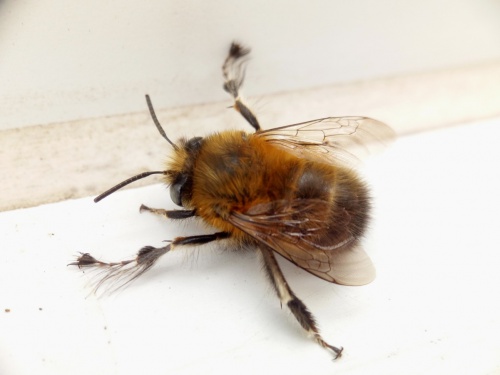
Flower bees (Anthrophora) are not true social bees, but live in colonies, sometimes very large. There are no worker bees.
The Bumblebee Species Guide is a useful summary and guide from the Bumblebee Conservation Trust, covering most UK species of Bombus.
Steve Falk's has produced some crib-sheets for BWARS, covering some of the more difficult species
- Cuckoo Bee females with white or cream tails
- Banded Red-tails
- 'Midriffed' white-tails and their dark forms
- Two-banded white/buff tails
- Bombus vestalis and Bombus bohemicus
- Distinguishing male Cuckoo bees
- Distinguishing Brown Carder Bees in the field
- Distinguishing black-bodied red-tails
Apidae - bumblebees, etc.