

Hybrid Crack-willow - Salix x fragilis
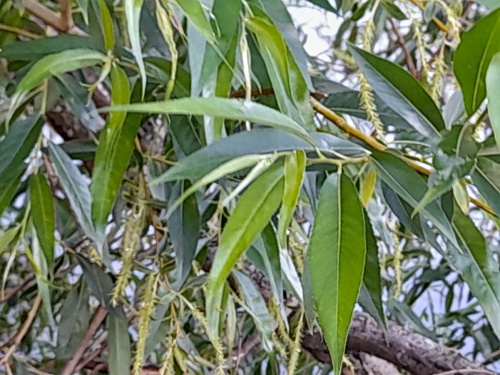
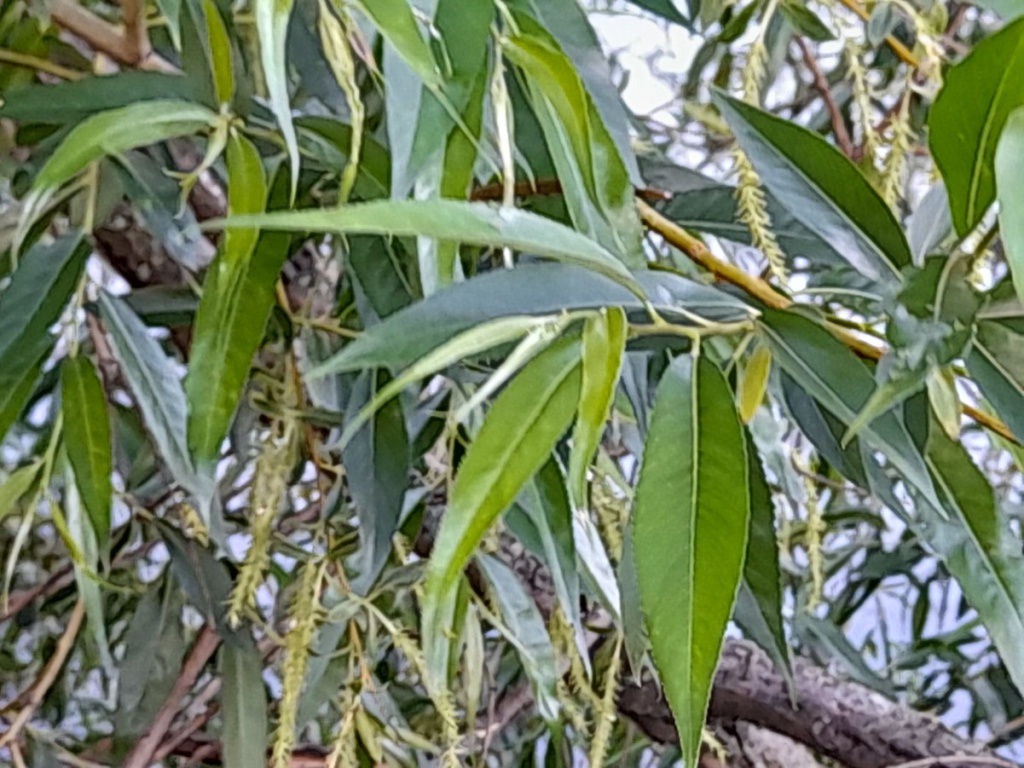
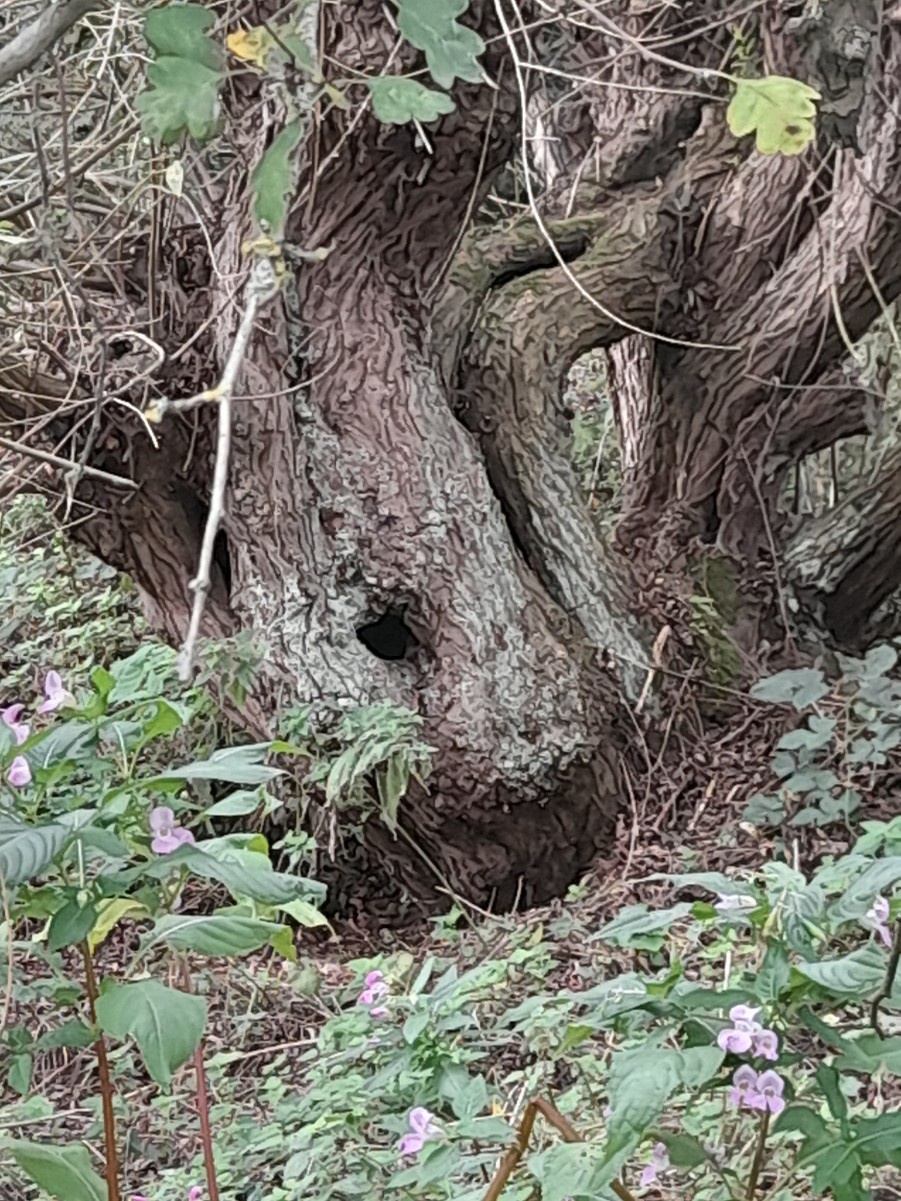
A robust tree, usually reaching 10 to15 metres high, its bark greyish and deeply fissured. Twigs soon glabrous and rather lustrous olive brown, brittle at the point of attachment to the branch. Mature leaves are lanceolate, 9 to 15 cm long and 1.5 to 3 cm wide, dark shining green above, greyish beneath, margins coarsely and unevenly serrate. Catkins appear with the leaves, terminal on short leafy shoots. Male catkins cylindrical 4 to 6 cm long and 1 to 1.3 cm wide, rather dense flowered, yellow. The female catkins are green. Seeds wind blow, surrounded by a tuft of woolly hairs.

Damp places, water margins and the edges of marsh areas.
Catkins April and May.
Deciduous.
Common in most of Britain as far North as Southern Scotland.
Common in Leicestershire and Rutland. In the 1979 Flora survey of Leicestershire it was found in 536 of the 617 tetrads.
, Granitethorpe Sapcote SP 4962 9363 (taken 12.10.2007).JPG) Graham Calow
Graham Calow
Granitethorpe Quarry, Sapcote
12 October 2007
leaves female flower Granitethorpe Sapcote SP 4962 9363 (taken 28.4.2008).JPG) Graham Calow
Graham Calow
Granitethorpe Quarry, Sapcote
28 April 2008
female catkin Male flower Tree by Marsh Sapcote SP 4978 9218 (taken 15.4.2009).JPG) Graham Calow
Graham Calow
Marsh near Old Fosse, Sapcote
15 April 2009
male catkins, female flower seeding Granitethorpe Sapcote SP 4962 9363 (taken 13.6.2008).JPG) Graham Calow
Graham Calow
Granitethorpe Quarry, Sapcote
13 June 2008
seeding catkins.JPG) Graham Calow
Graham Calow
Granitethorpe Quarry, Sapcote
12 October 2007
clean break under pressure Granitethorpe Sapcote SP 4962 9363 (taken 12.10.2007)..JPG) Graham Calow
Graham Calow
Granitethorpe Quarry, Sapcote
12 October 2007
, Granitethorpe Sapcote SP 4962 9363 (taken 12.10.2007).JPG)
 female flower Granitethorpe Sapcote SP 4962 9363 (taken 28.4.2008).JPG)
 Male flower Tree by Marsh Sapcote SP 4978 9218 (taken 15.4.2009).JPG)
, female flower seeding Granitethorpe Sapcote SP 4962 9363 (taken 13.6.2008).JPG)
.JPG)
 Granitethorpe Sapcote SP 4962 9363 (taken 12.10.2007)..JPG)
Leicestershire & Rutland Map
Enter a town or village to see local records
MAP KEY:
Yellow squares = NBN records (all known data)
Coloured circles = NatureSpot records: 2025+ | 2020-2024 | pre-2020
UK Map
Species profile
- Common names
- Hybrid Crack-willow, Fork-flowered Willow, Crack-willow
- Species group:
- flowering plant
- Kingdom:
- Plantae
- Order:
- Malpighiales
- Family:
- Salicaceae
- Records on NatureSpot:
- 161
- First record:
- 01/01/1979 (Patricia Evans)
- Last record:
- 06/10/2025 (Pochin, Christine)
Total records by month
% of records within its species group
10km squares with records
The latest images and records displayed below include those awaiting verification checks so we cannot guarantee that every identification is correct. Once accepted, the record displays a green tick.
In the Latest Records section, click on the header to sort A-Z, and again to sort Z-A. Use the header boxes to filter the list.
Latest images
Latest records
 Kaye Lou
Leicester City Centre, Liberty Roundabout
27 May 2022... bark Granitethorpe Sapcote SP 4962 9363 (taken 12.10.2007).JPG) Graham Calow
Graham Calow
Granitethorpe Quarry, Sapcote
12 October 2007
bark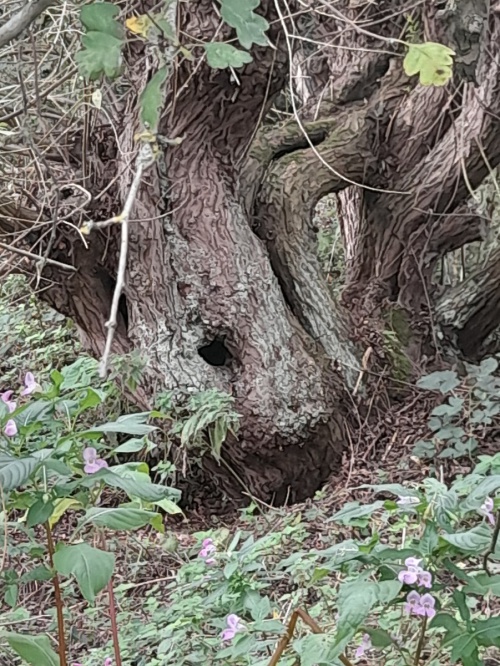 Kaye Lou
Aylestone, Aylestone Meadows
15 September 2022
... bark Granitethorpe Sapcote SP 4962 9363 (taken 12.10.2007).JPG)
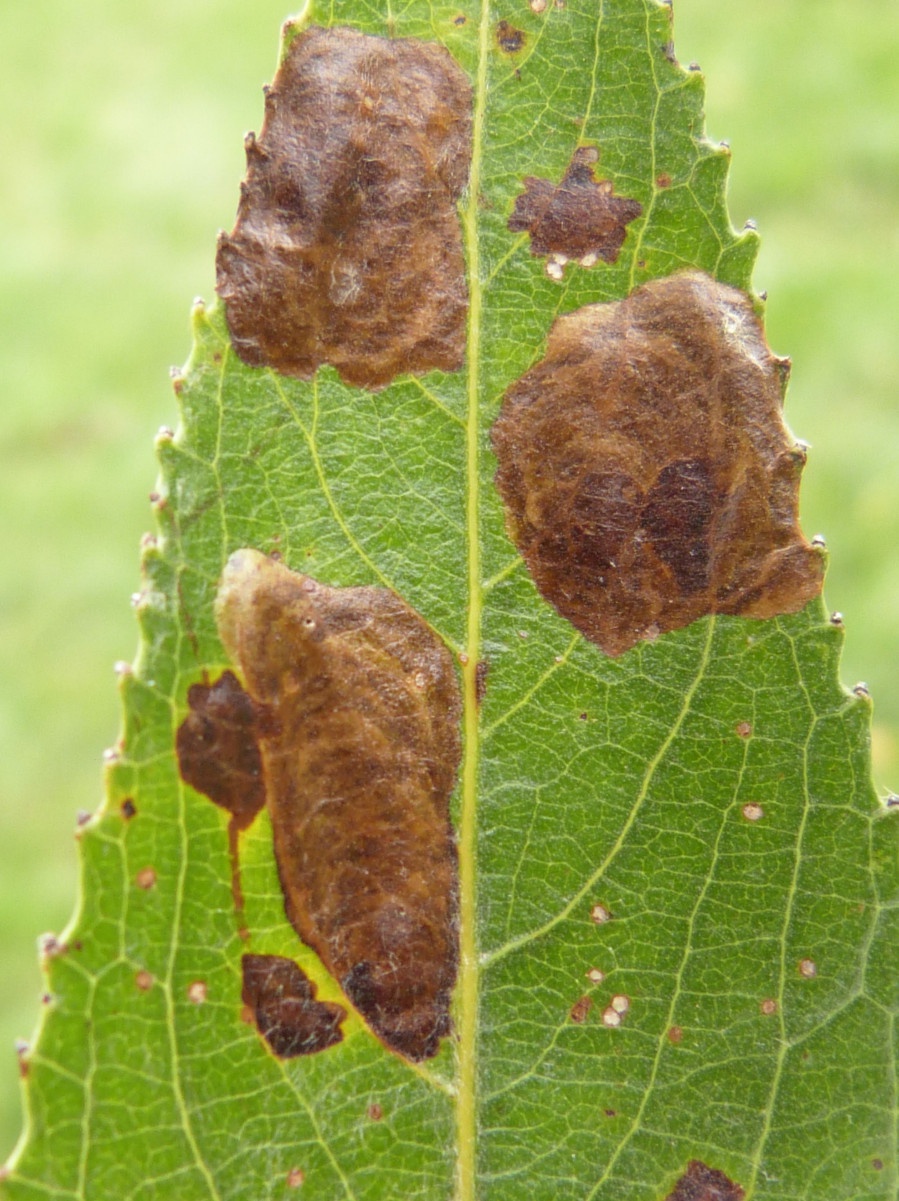
Isochnus sequensi
The larvae of this small (2-2.5mm) black weevil feed on willow leaves, forming brown blotch mines. There are two Ischnus species that create identical mines so the larvae need to be reared to adults to know which species.

Willow Redgall Sawfly
The larvae of the Willow Redgall Sawfly (Euura proxima) produce galls on narrow-leaved willows such as Hybrid Crack-willow (Salix x fragilis) and White Willow (Salix alba). The gall is bean-shaped, starting off green but gradually turning red. It is smooth with a thick wall and protrudes from both the upper and lower leaf surface.
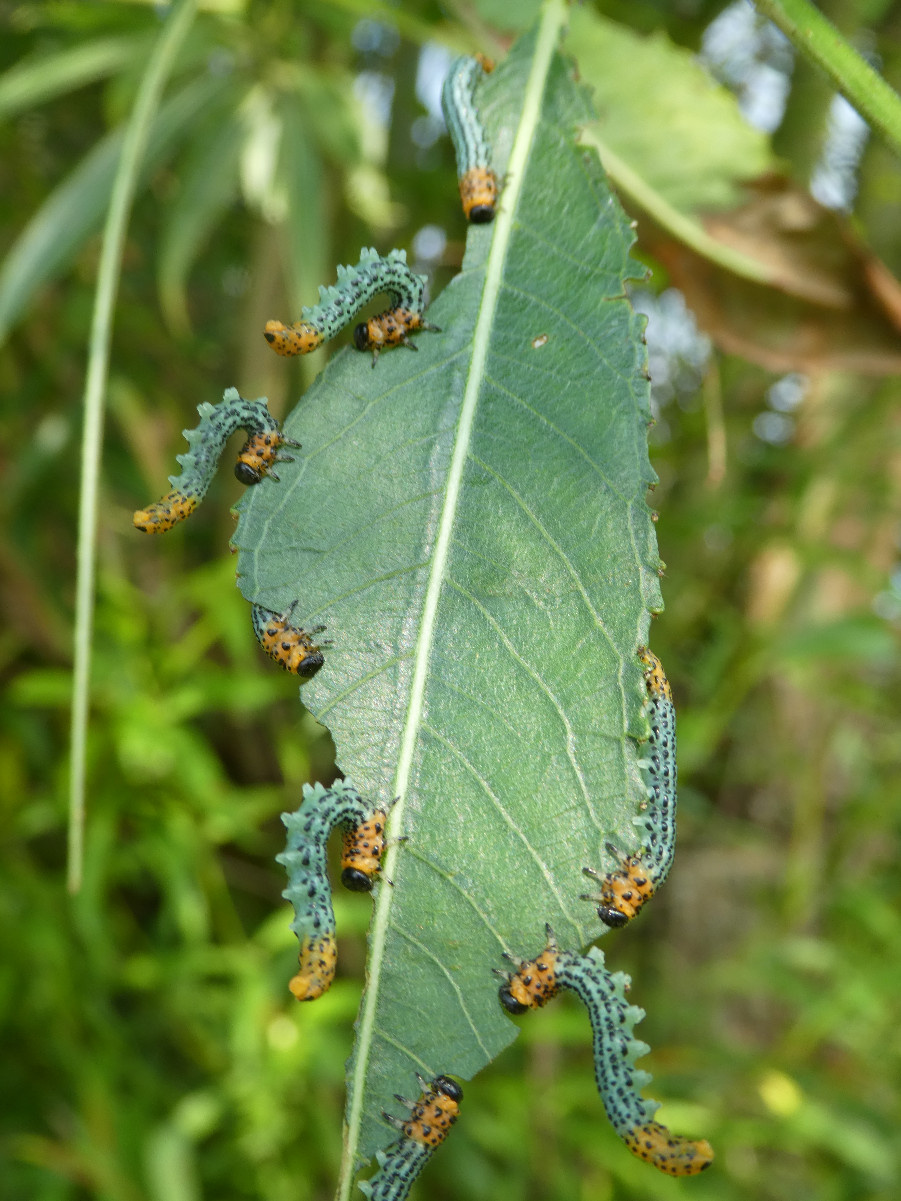
Euura salicis
The distinctive larvae of Euura salicis feed on the leaves of narrow-leaved willows such as Hybrid Crack-willow and White Willow feeding along the leaf edge.
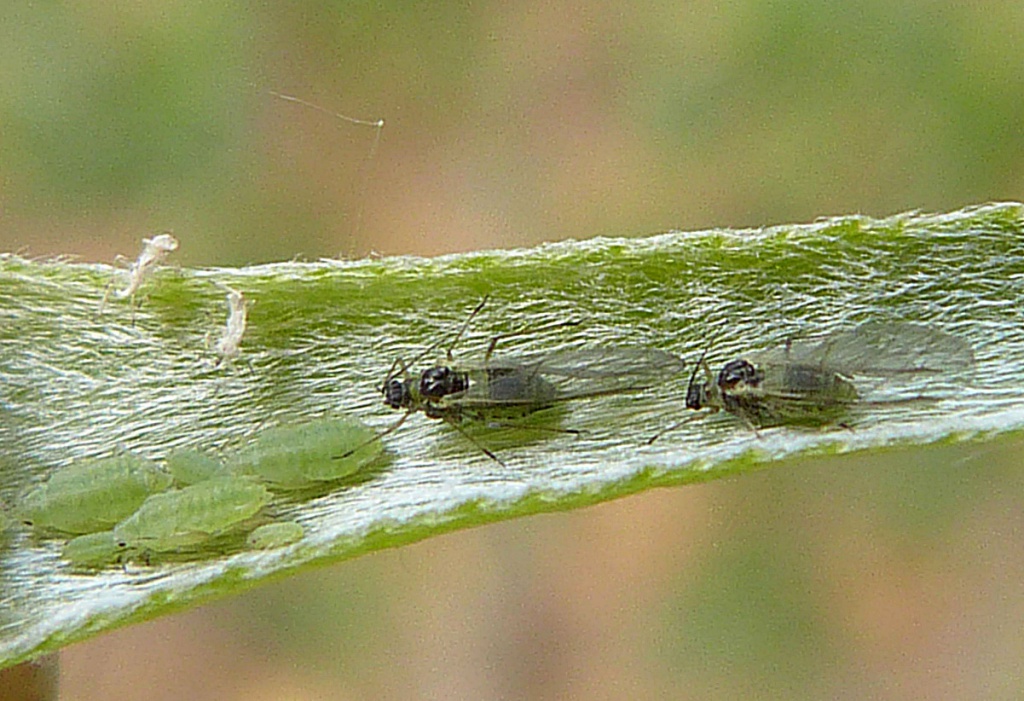
Willow-carrot Aphid
The Willow-carrot aphid (Cavariella aegopodii) host alternates from Willows (Salix sp.) to umbellifers (Apiaceae). The preferred primary hosts are Hybrid Crack-willow and White Willow.
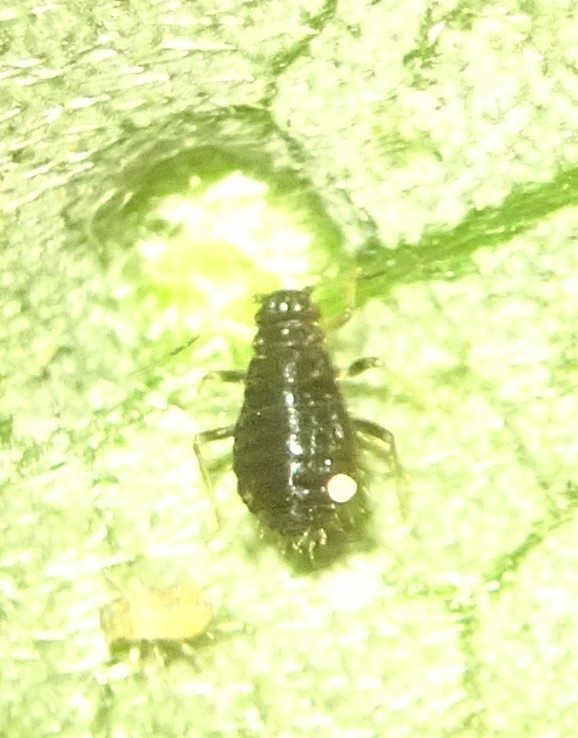
Chaitophorus salijaponicus subsp. niger
The aphid Chaitophorus salijaponicus subsp. niger live separately or in small colonies on the leaves of narrow-leaved Willows such as Hybrid Crack-willow or White Willow. The adult apterae are usually uniformly blackish-brown.
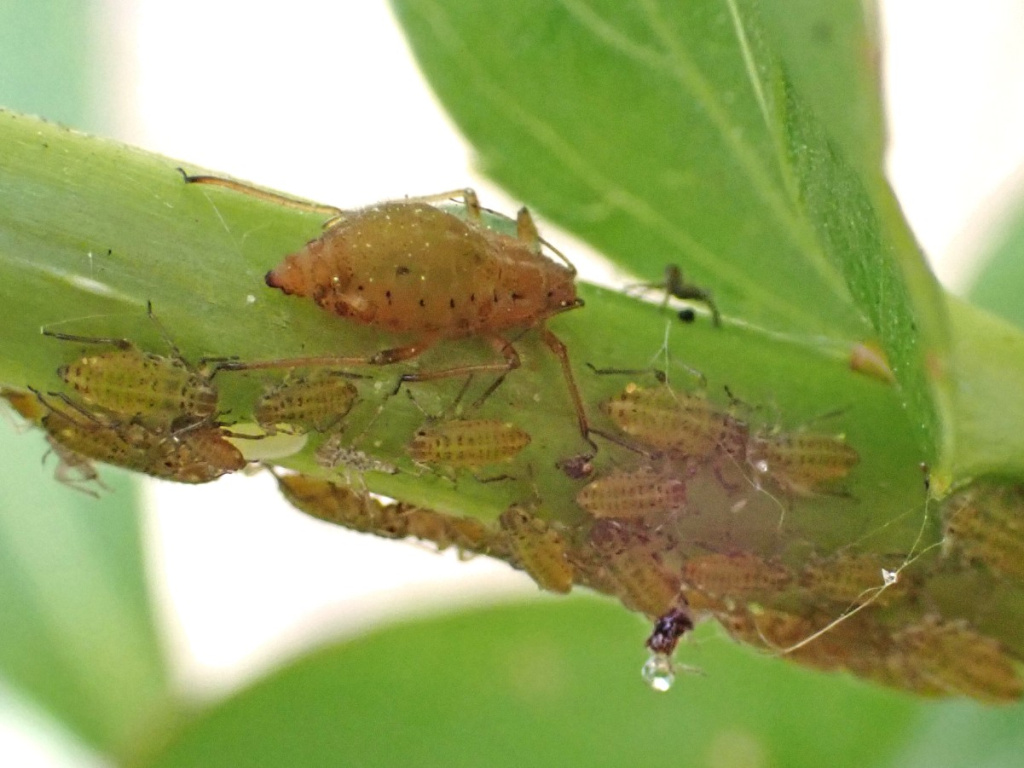
Rufous Willow Bark Aphid
The Rufous Willow Bark Aphid (Pterocomma rufipes) primarily lives on the twigs and young branches of a variety of Salix species. It can be found on both broad-leaved willows such as Grey Willow and Goat Willow and also on narrow-leaved willows such as Hybrid Crack-willow and White Willow.
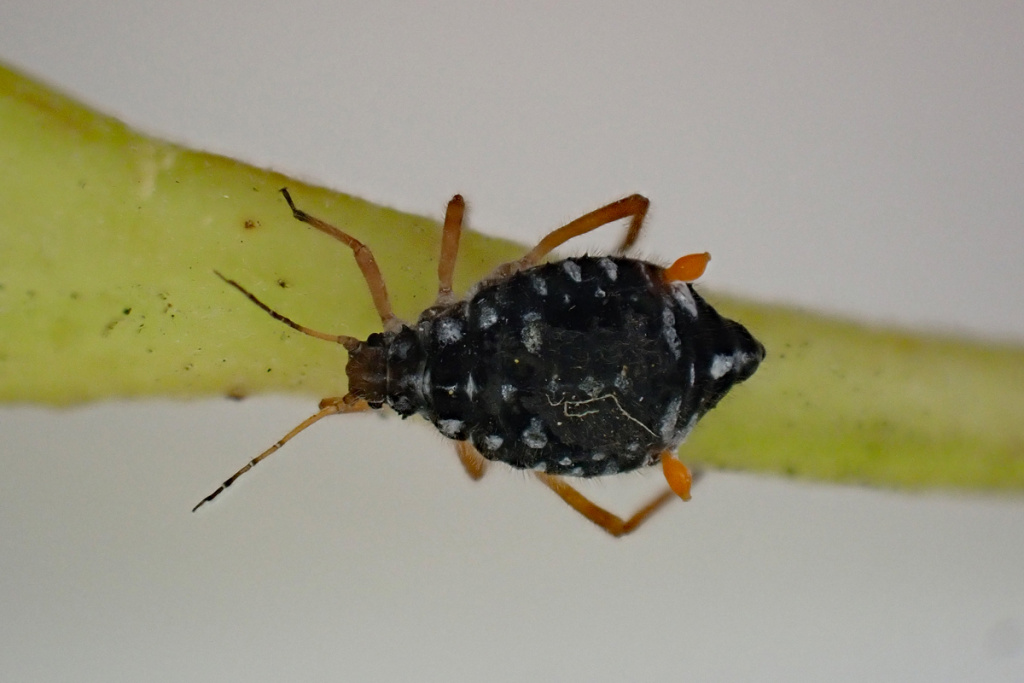
Black Willow Bark Aphid
Black Willow Bark Aphid (Pterocomma salicis) uses a variety of Salix species including Osier, White Willow, Goat Willow, Grey Willow, and Hybrid Crack-willow. These are large greenish black to black aphids 3.2 - 4.5 mm in length with pale grey spots of waxy powder. The siphunculi are bright orange. The legs and antennae are pinkish-brown.
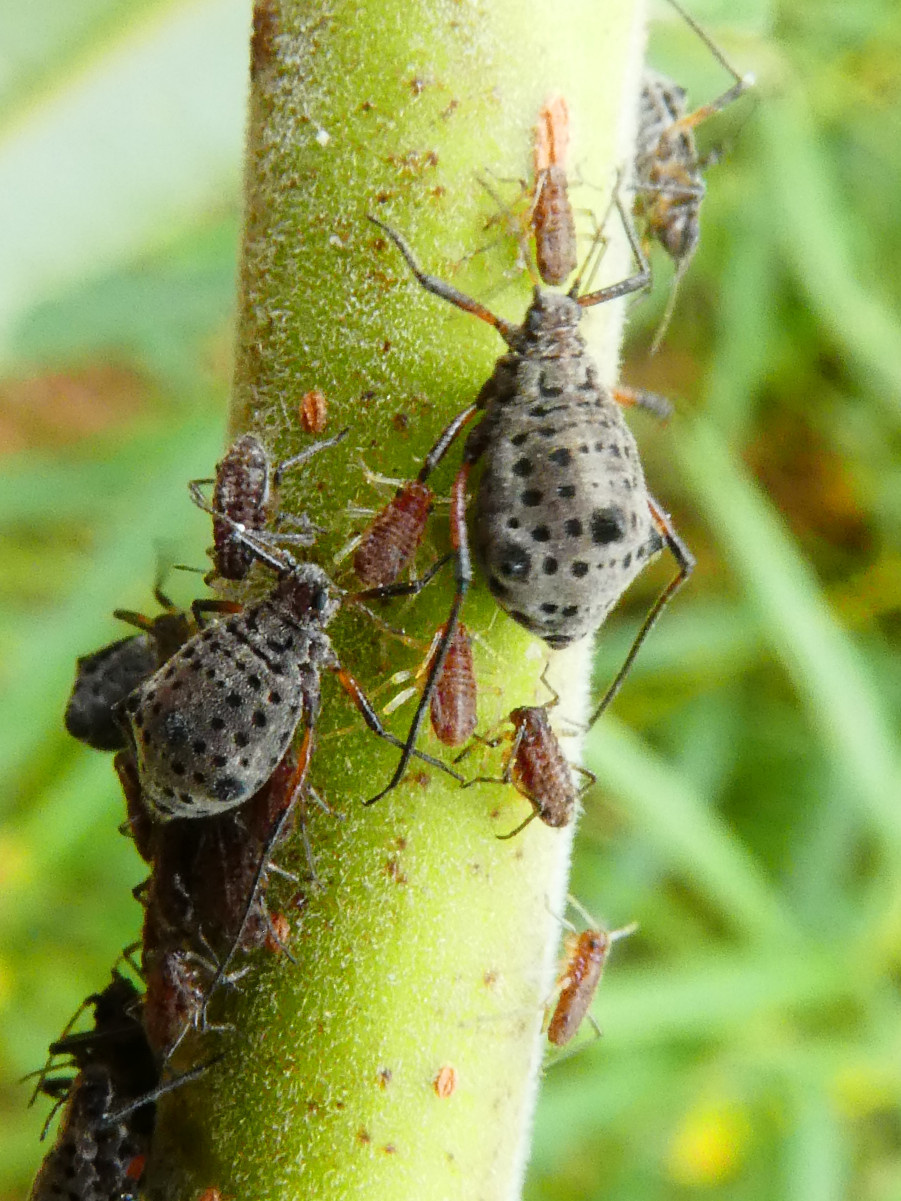
Giant Willow Aphid
The Giant Willow Aphid (Tuberolachnus salignus) is found primarily in large colonies on the trunks and branches of willow and sallow trees. Giant Willow Aphids are dark brown with a peppering of black spots but can appear grey from a white dust which forms on them. It is an unusually large aphid, measuring up to 6mm long. Adults of the species have a thorn-like tubercle which protrudes from its back. As with other species of aphid, some giant willow aphids are winged; an adaptation believed to emerge in reaction to environmental pressures. The aphids splay their back legs and kick in response to potential threats.
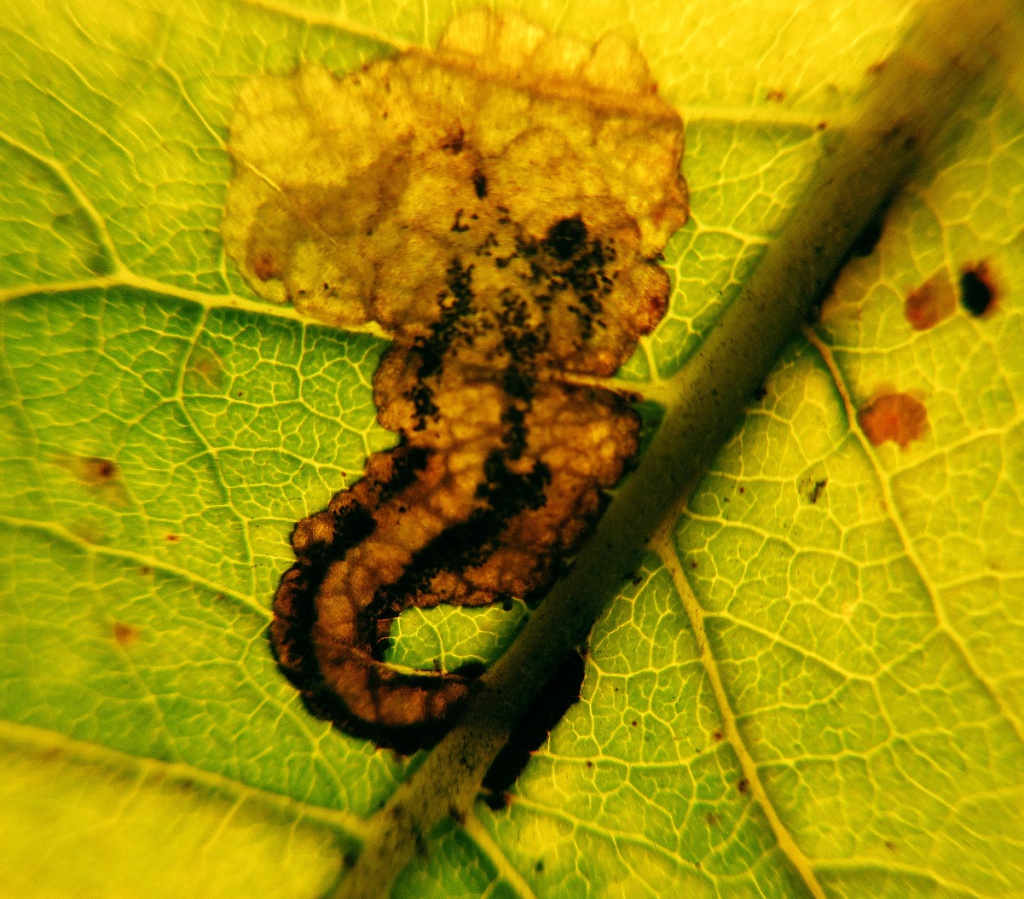
Ectoedemia intimella
The larva of the moth Ectoedemia intimella mines the leaves of various species of Willow especially Goat Willow and Grey Willow initially galling the leaf petiole before moving to the the midrib of the leaf. Subsequently it mines into the leaf-blade, forming a distinctive blotch which often contains two lines of frass.
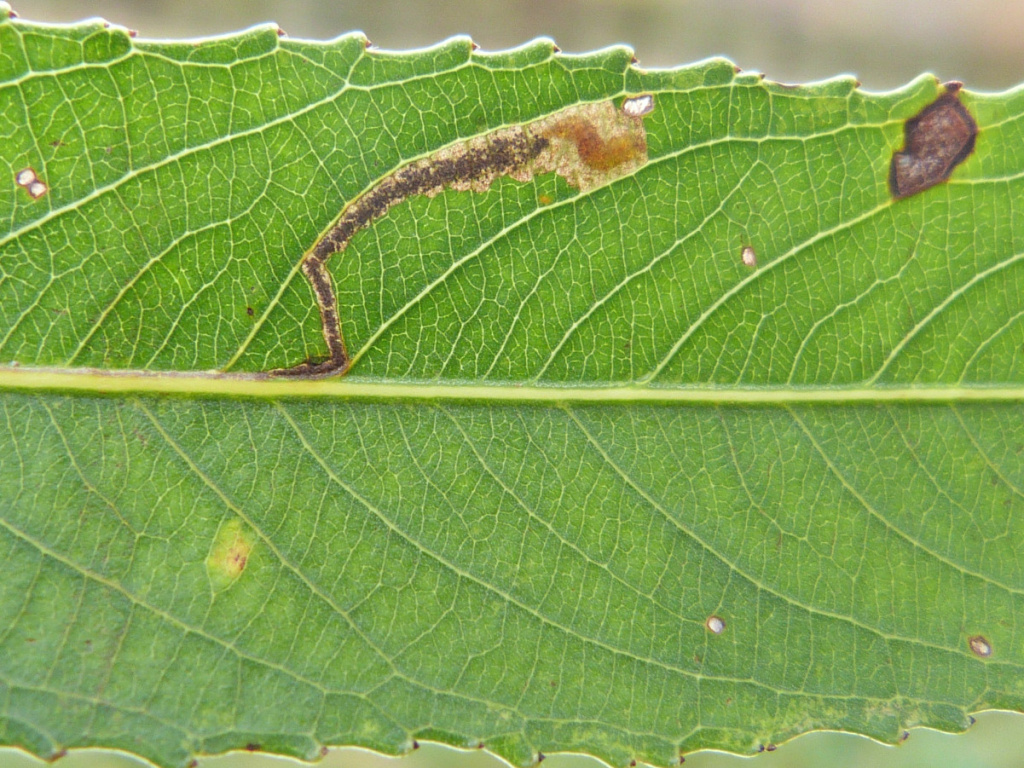
Stigmella obliquella
The larva of the moth Stigmella obliquella mines the leaves of various smooth-leaved willows including Weeping Willow, Purple Willow, Osier, White Willow and Hybrid Crack-willow causing an angular gallery mine
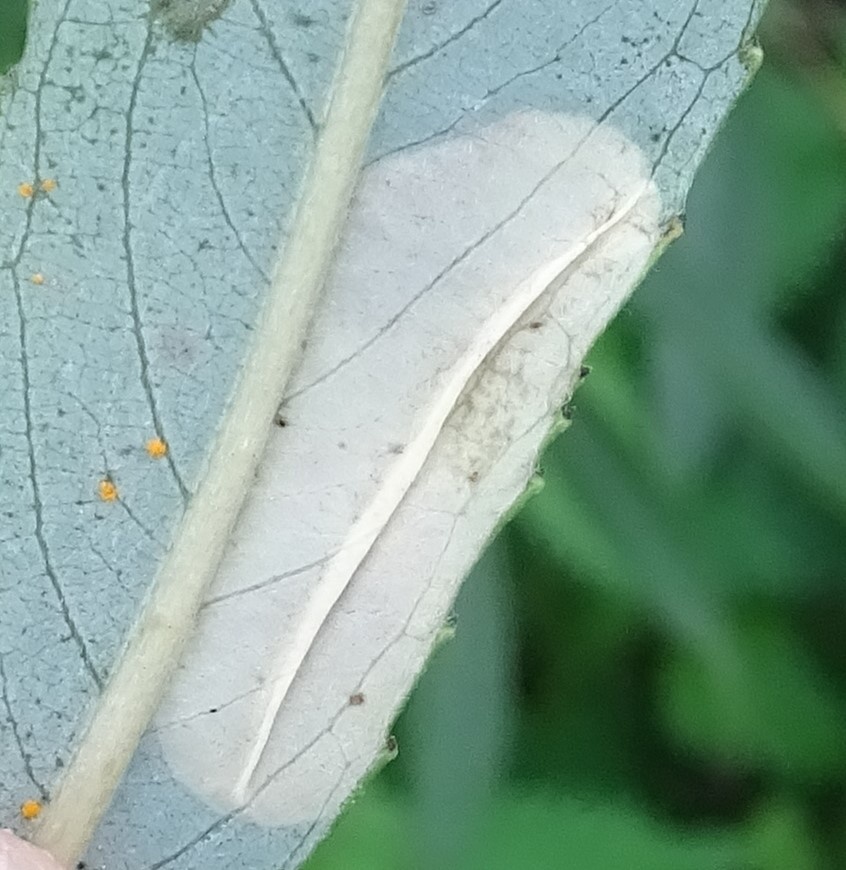
Phyllonorycter pastorella
The larva of the moth Phyllonorycter pastorella mines the leaves of some smooth-leaved willows such as Weeping Willow, White Willow and Hybrid Crack-willow. The mines are large and have a single sharp crease on the undeside.
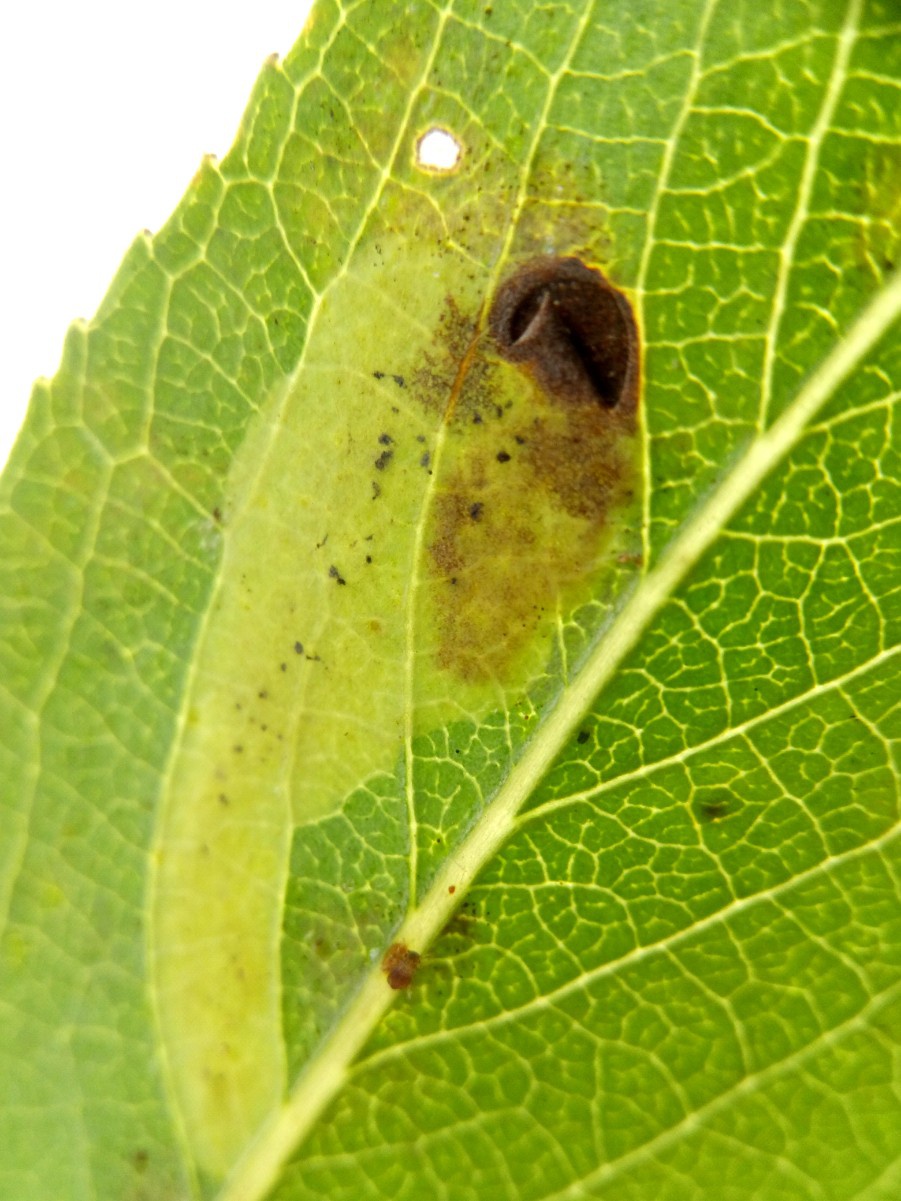
Aulagromyza tridentata
The larva of the Agromyzid fly Aulagromyza tridentata mines the leaves of willows such as Hybrid Crack-willow and Osier producing an elongated yellowish blotch mine.
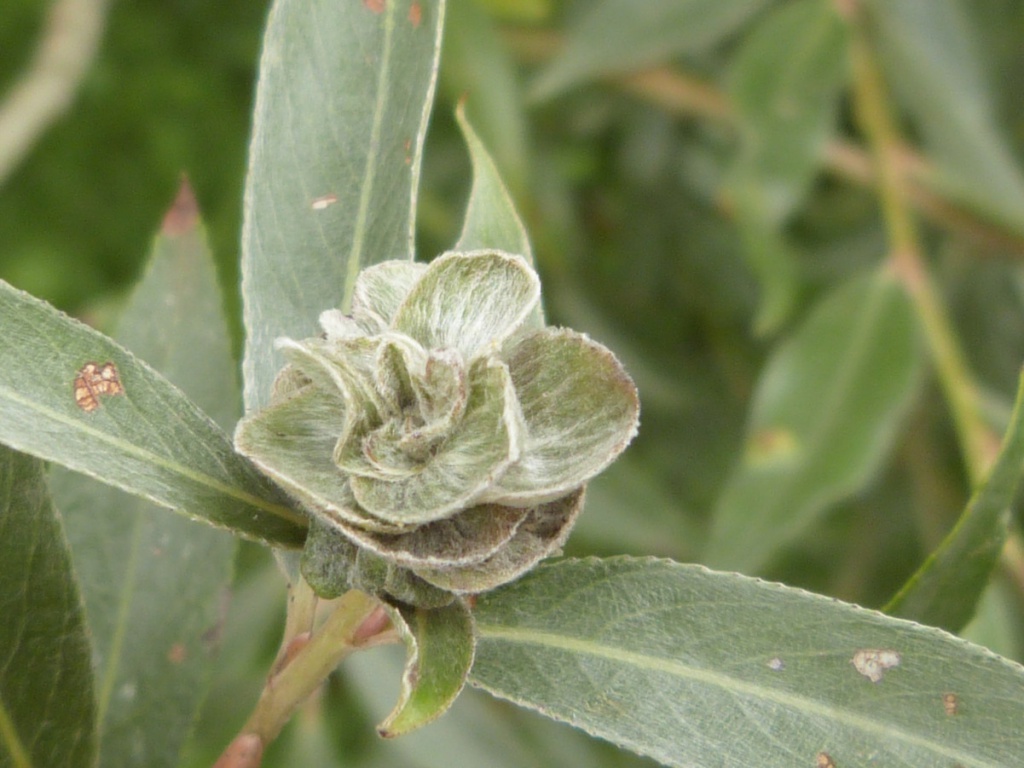
Rabdophaga rosaria
The midge larvae of Rabdophaga strobilina / rosaria agg. cause a conspicuous rosette shaped gall to form in the terminal bud of various willows especially White Willow. Often more than 20 mm across the gall has a central chamber which contains a pink or red larva. The galls often remain on the host plant through winter.
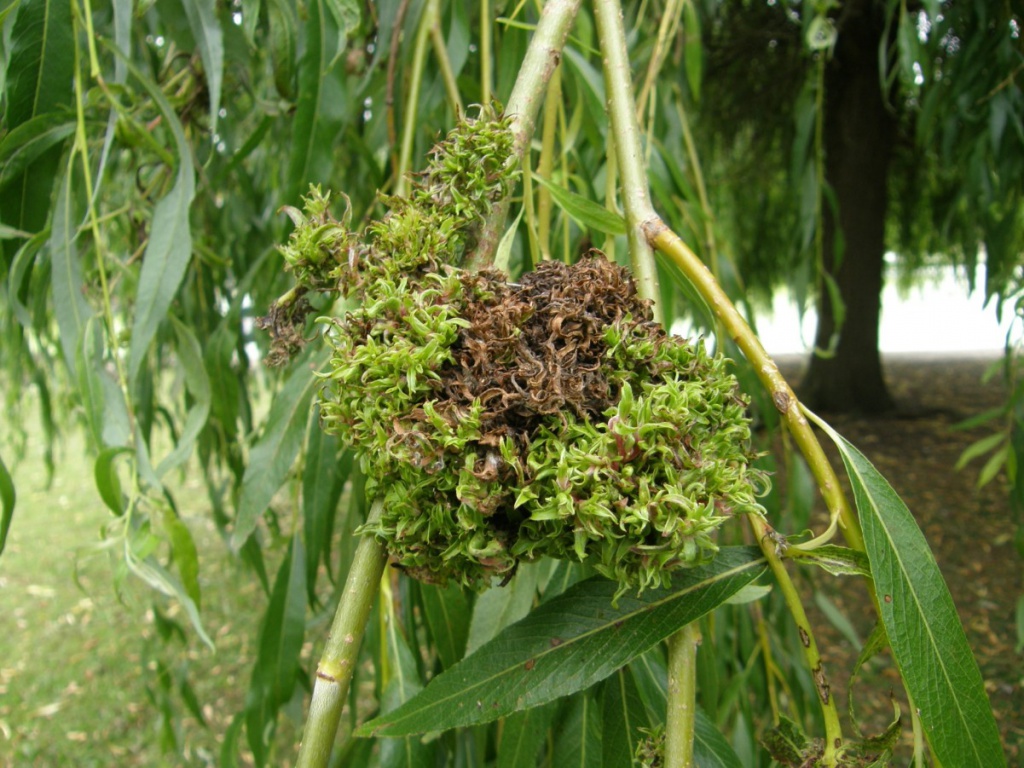
Mossy Willow Catkin Gall
This gall is actually an abnormally distorted catkin, and is probably caused by a virus or phytoplasma ( a type of Bacteria), but the precise causer has not yet been identified. It used to be thought that it was caused by the mite Stenacis triradiatus but it now seems that the mites just choose to live in and around these galls. The galls can be very large and variable in shape and degree of distortion of the catkin - often the gall forms a green straggly mass, or it can be more of a woody mass. In our experience it has been found most commonly on Hybrid Crack-willow.
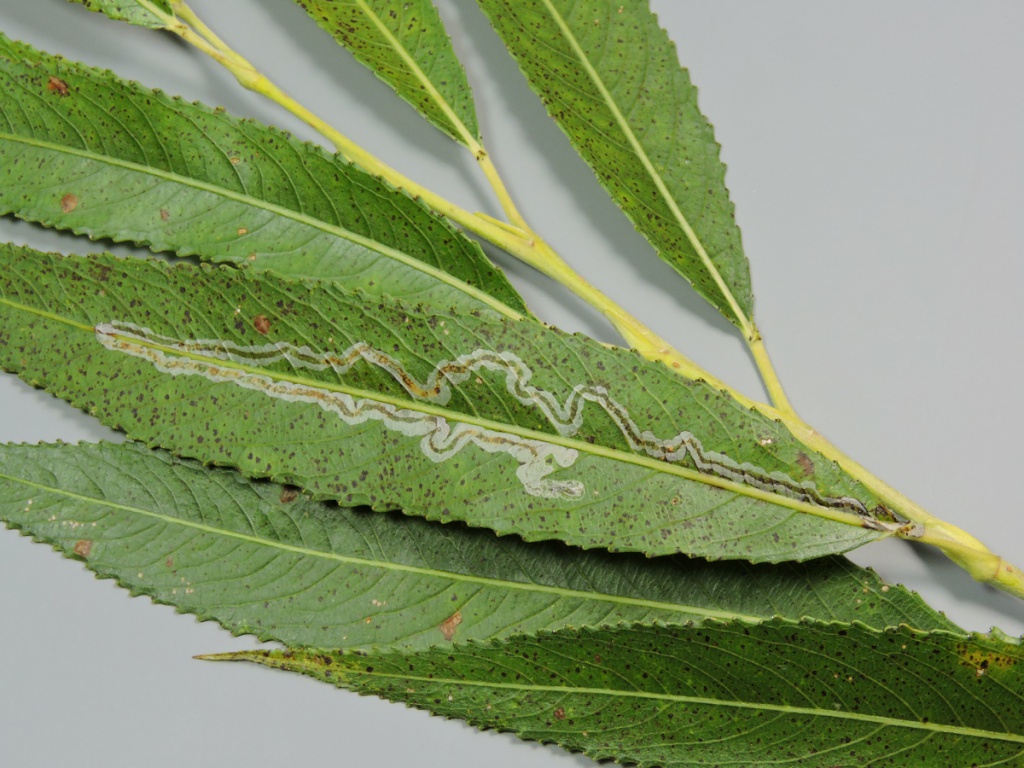
Phyllocnistis saligna
The larva of the moth Phyllocnistis saligna mines the leaves of various smooth-leaved willows, causing a thin silvery mine like a snail-trail in the upper epidermis of the leaf, and contuning down the twig to mine another leaf. Pupation is under a leaf-fold at the edge of a leaf.
Phyllocnistis saligna has been shown to be a complex of several species, and it is likely that most (all?) VC55 records are actually referable to Phyllocnistis asiatica. The status of both species is under review, via both host species and mine morphology, along with DNA analysis. In the meantime, records entered as Phyllocnistis saligna where no dissection of an adult female has been completed are considered to be Phyllocnistis saligna/asiatica agg., and will be re-determined as such if/when a UKSI species code is created for this purpose.