

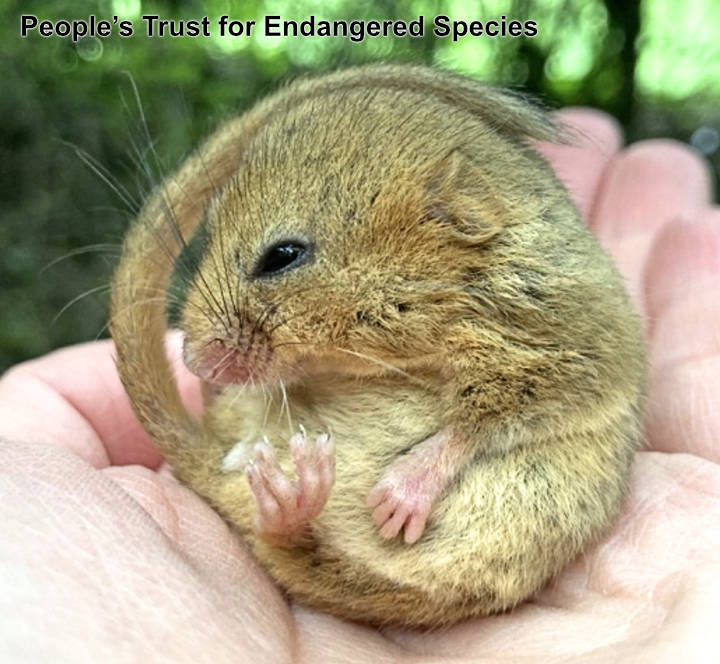
Over 40 rare hazel dormice have been reintroduced into a Leicestershire woodland this week. More...
Hazel Dormice are the only small British mammal with a furry tail, and with their golden-brown fur, large black eyes and long whiskers, are very endearing. They’re nocturnal animals that are active from late spring into summer and autumn, spending much of their time in tree and shrub canopies, and hibernate over winter in nests on the ground. Their long-term decline reflects the loss of many old woodlands over the last century, the lack of management of those that are left, and the removal and neglect of hedgerows no longer needed to enclose livestock. Building on the 2025 reintroduction in the same woodland, this further release helps to restore a native species that has declined by over 70% nationally since 2000. The release, organized by a partnership including the People’s Trust for Endangered Species, Leicestershire and Rutland Wildlife Trust and the Leicestershire & Rutland Mammal Group, is part of an ongoing national reintroduction programme which, for over 30 years, has been restoring this declining native species to woodlands across Britain in a bid to save dormice from extinction. Last year 21 of the tiny mammals were released into the same woodland on the Bradgate Park Trust estate, creating Leicestershire’s only known population.
Ian White, Dormouse & Training Officer at People’s Trust for Endangered Species explains: “Hazel dormice have declined by over 70% nationally since 2000 due to habitat loss, poor woodland and hedgerow management and climate change. These figures are extremely concerning, but over the past 30 years our reintroduction programme, alongside habitat restoration, sympathetic woodland management and monitoring, is giving this threatened species a real chance of recovery. And, on a local level, by releasing more dormice into Bradgate Park this week, we are one step closer to creating a larger, connected population that hopefully will one day span the whole National Forest, giving further cause for hope.”
Since their release in June 2025, local volunteers and rangers have been regularly monitoring the dormice using nest boxes at Bradgate Park. These boxes help keep tabs on the reintroduced population and reveal evidence of breeding. Encouragingly the team has found a growing number of dormouse nests across the woodland, reflecting the growing population. 46 dormouse nests were found in the October 2025 check, and there was evidence of breeding too, with 11 young recorded in August and 15 in September.
Like last year, volunteers from Bradgate Park Trust play a vital role in helping the dormice settle in. On the reintroduction day dormice are paired up in nest boxes which are placed into large mesh enclosures filled with natural food, foliage and water, mimicking the wider woodland. Volunteers monitor the dormice daily, replenishing food and water, and over this time the dormice can adjust to the sights, sounds and smells of their new woodland home from the safety of their enclosures. Then, after ten days, wildlife vets return for a final health check before the cage doors are opened and the dormice are free to explore the woodland, breed and eventually spread into neighbouring areas. The location of this year’s woodland was carefully selected with the help of the Leicestershire & Rutland Wildlife Trust, the Leicestershire & Rutland Mammal Group, the National Forest and Twycross Zoo.