

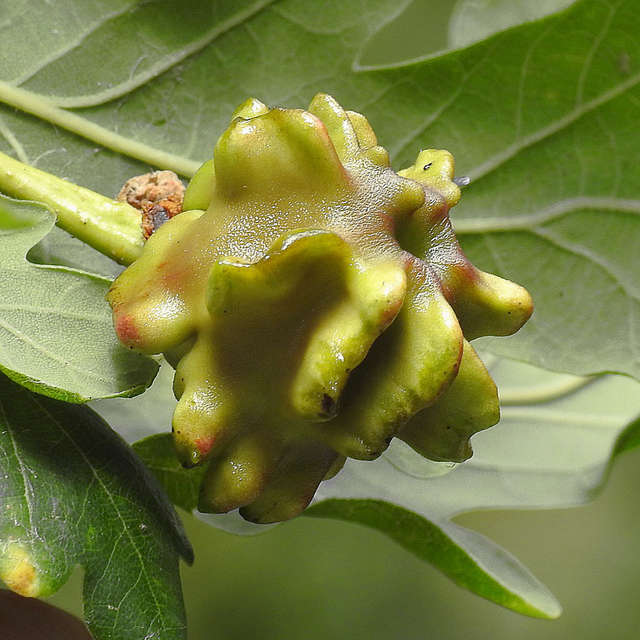
Can you remember last autumn? It's a clue to what is happening now. More...
Autumn 2022 was what is known as a "mast year". Oaks (Quercus robur) produced a massive crop of acorns. Oaks do this in alternate years - it's thought to be a means of controlling the populations of all the things that eat acorns, and so helping more Oak trees develop. Big things like squirrels and Jays eat acorns, but so do lots of little things, such as the Knopper Oak Gall Wasp, Andricus quercuscalicis. Last year the gall wasp had an unlimited host acorn supply so its population increased hugely. The Oaks didn't care as there were so many acorns that only a small proportion were affected by galls.
This year, there are a lot of female wasps competing for a small number of acorns, so the percentage of acorns affected by Knopper galls is very high. Some Oaks may lose 100% of their acorns to Knopper galls, and it is common to find acorns are attacked by multiple wasps and so carrying many galls - up to 10 on a single acorn cup. Any Oak tree producing large numbers of acorns this year would suffer a big loss on its investment. The prediction is that next year there will be a smaller population of gall wasps, so the acorn crop will be relatively unaffected.
So it's Competition Time! What is the largest number of Knopper Galls you can find on a single acorn cup?
Thanks to Mick Crawley, Silwood Park, for the inspiration.