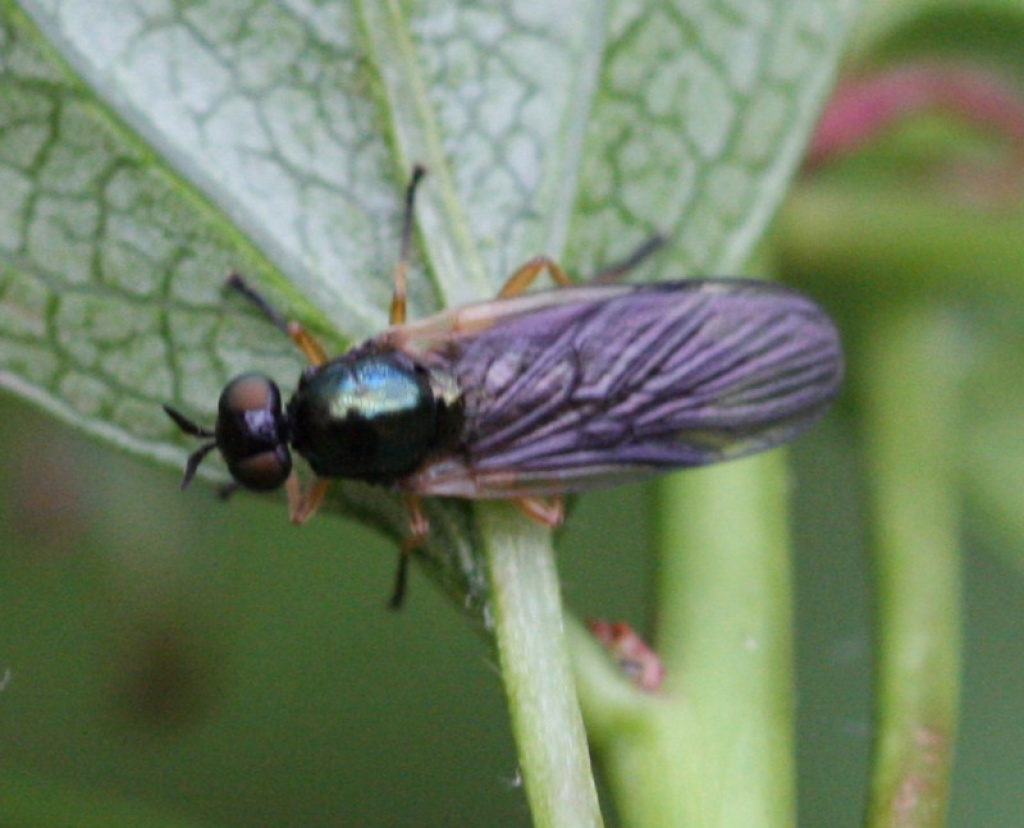
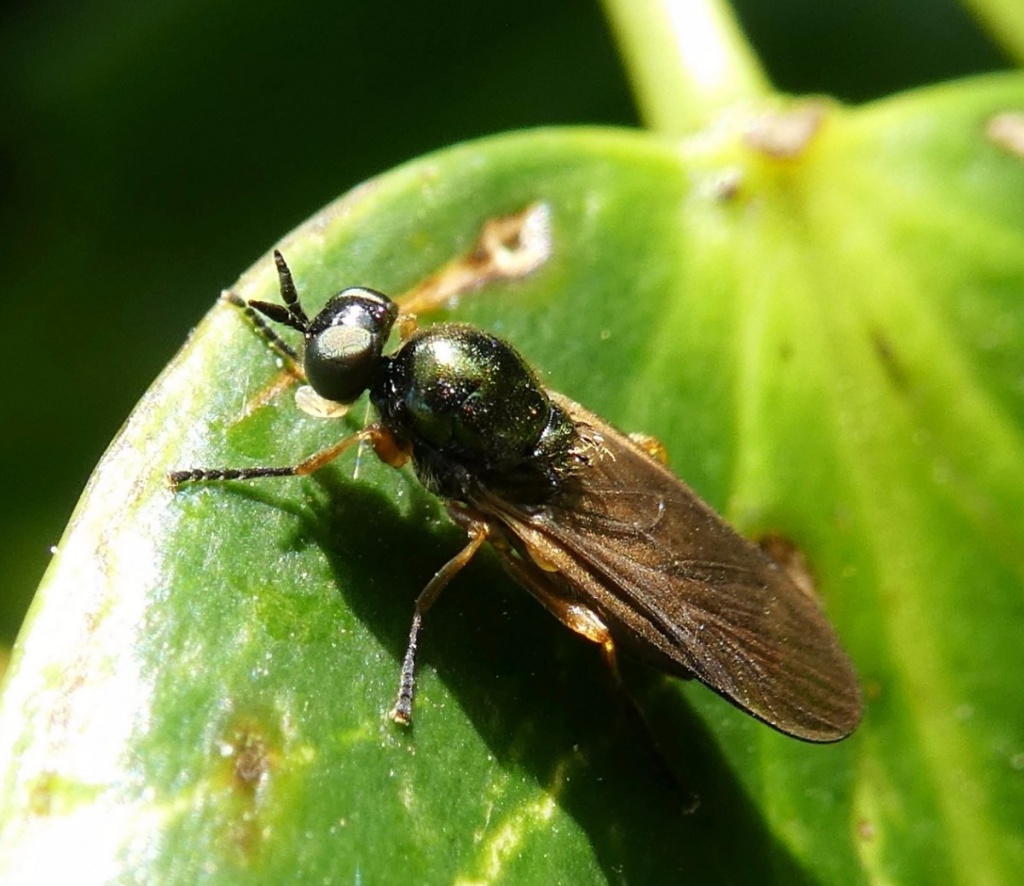
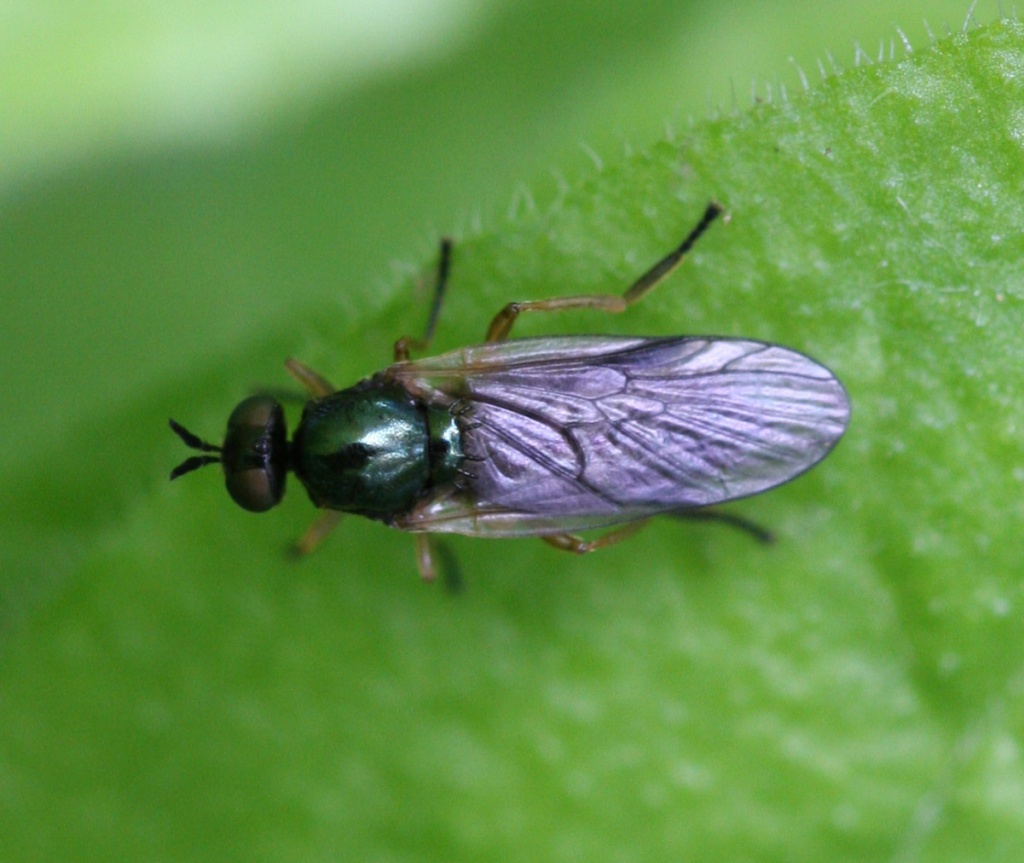
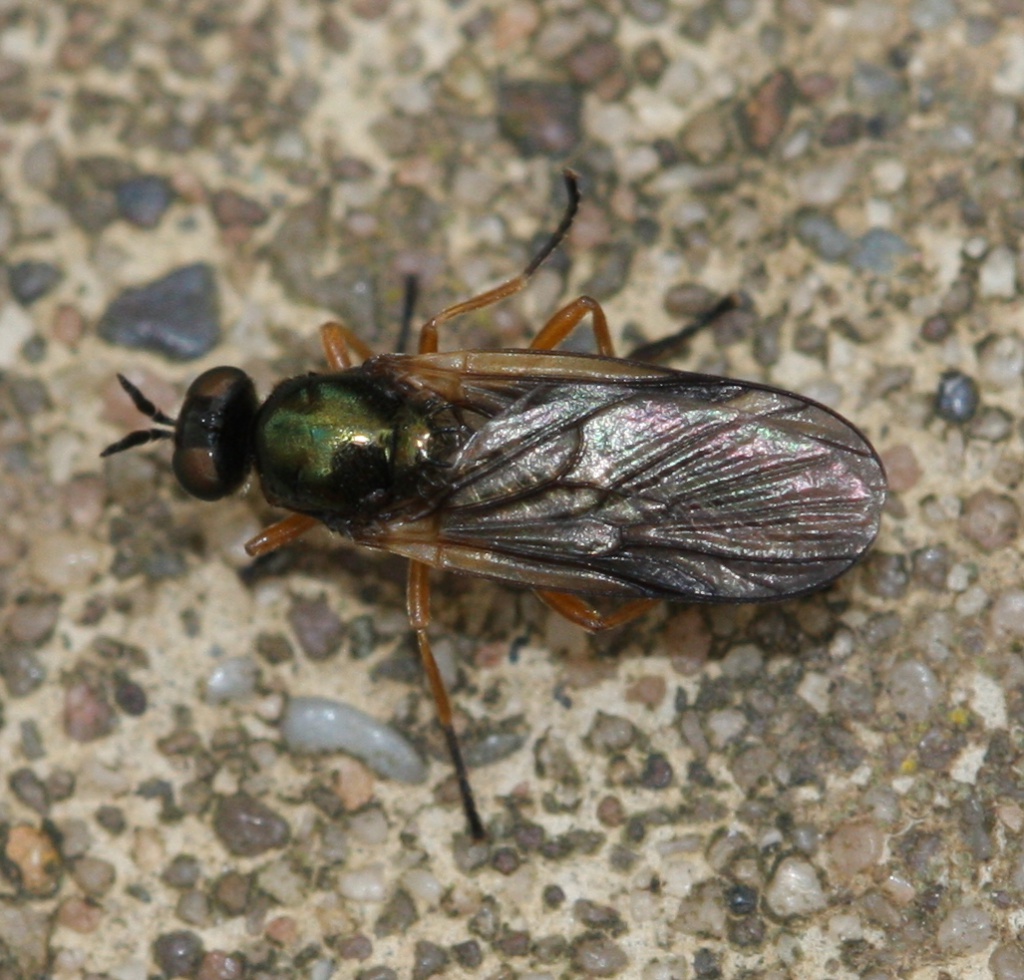
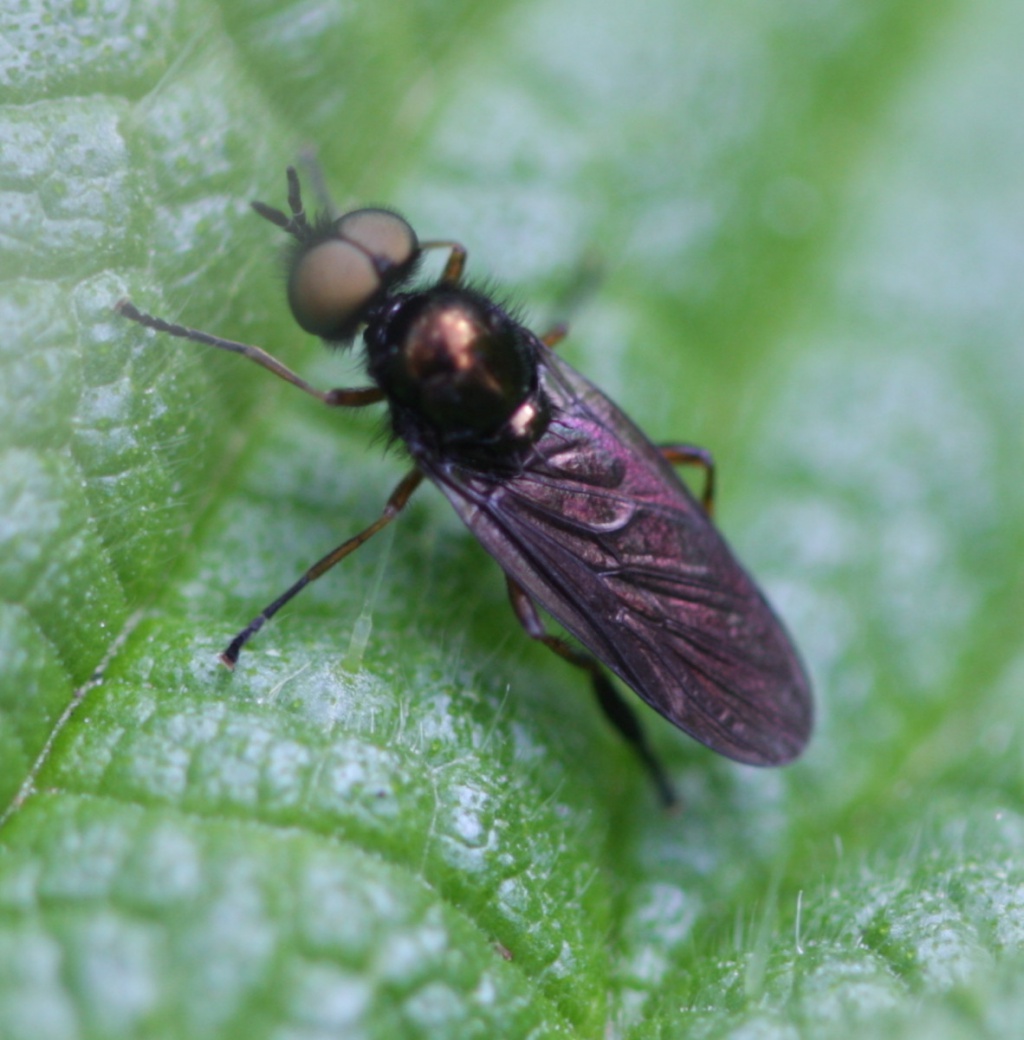
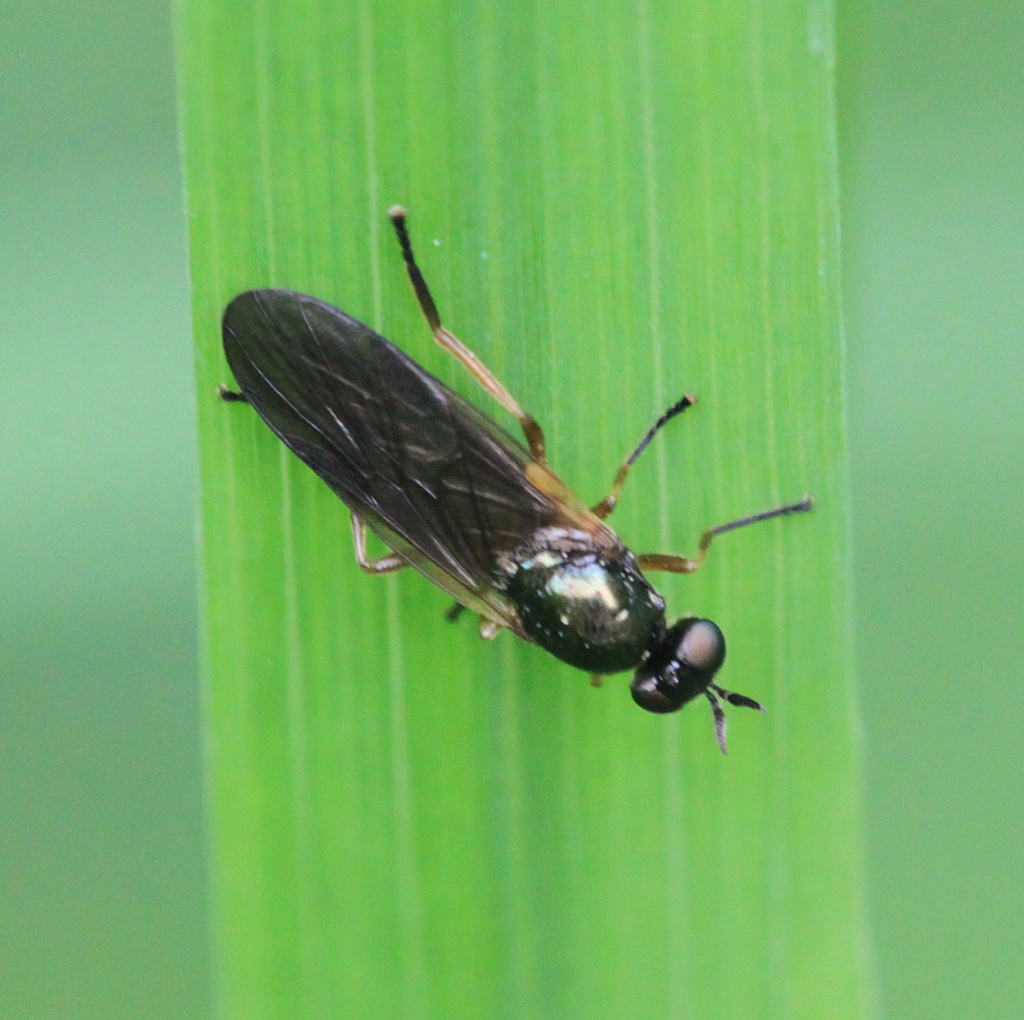
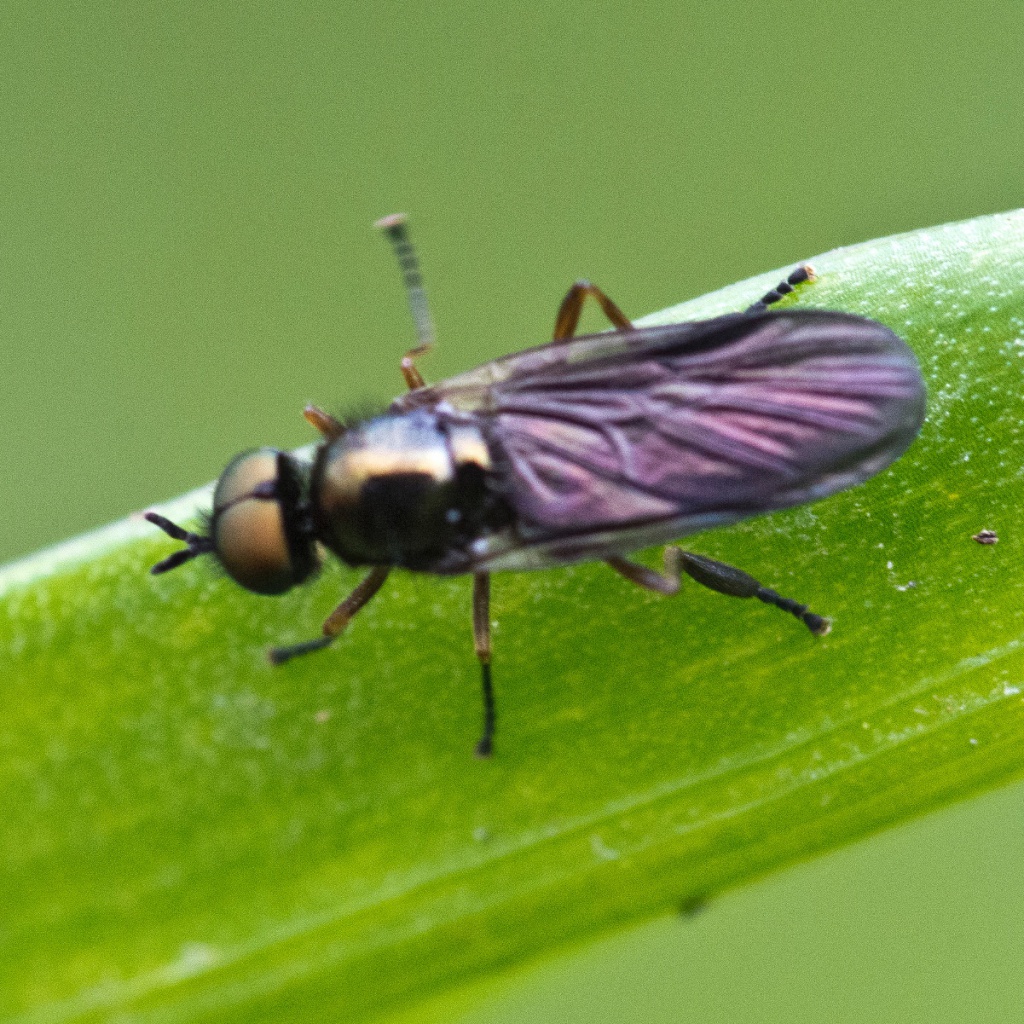
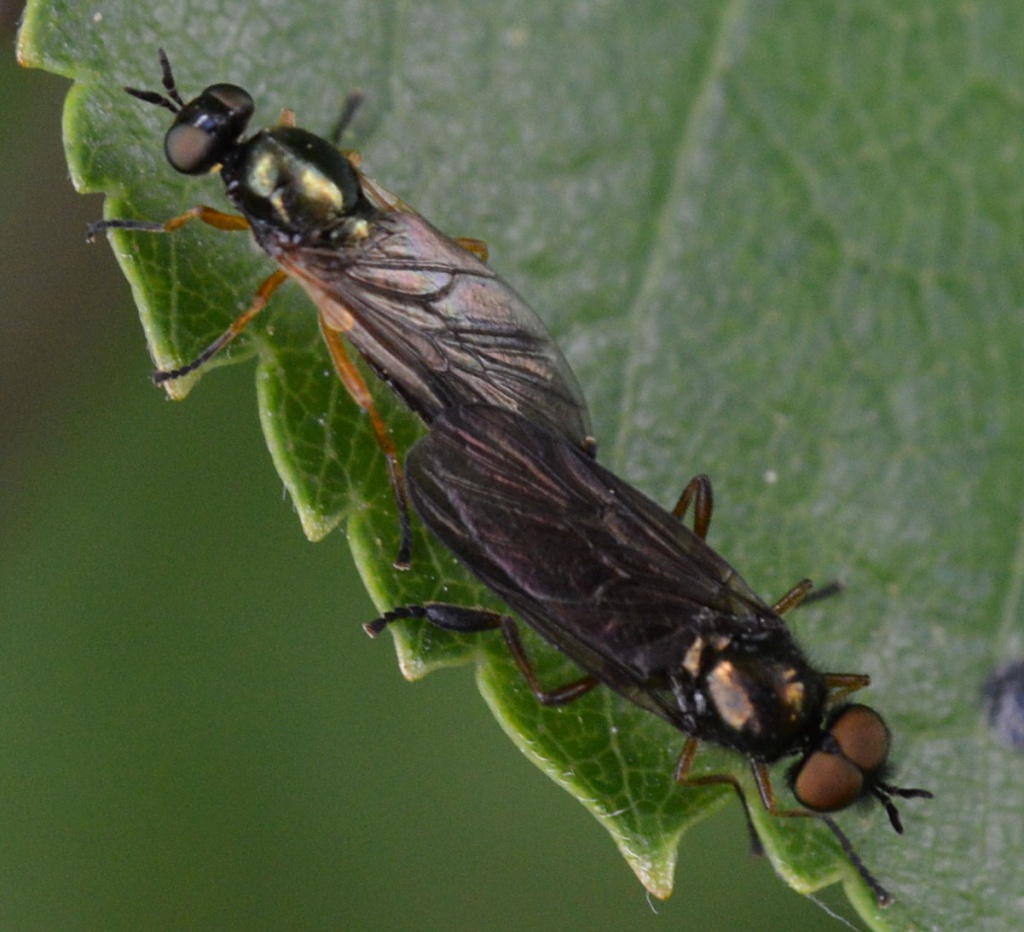
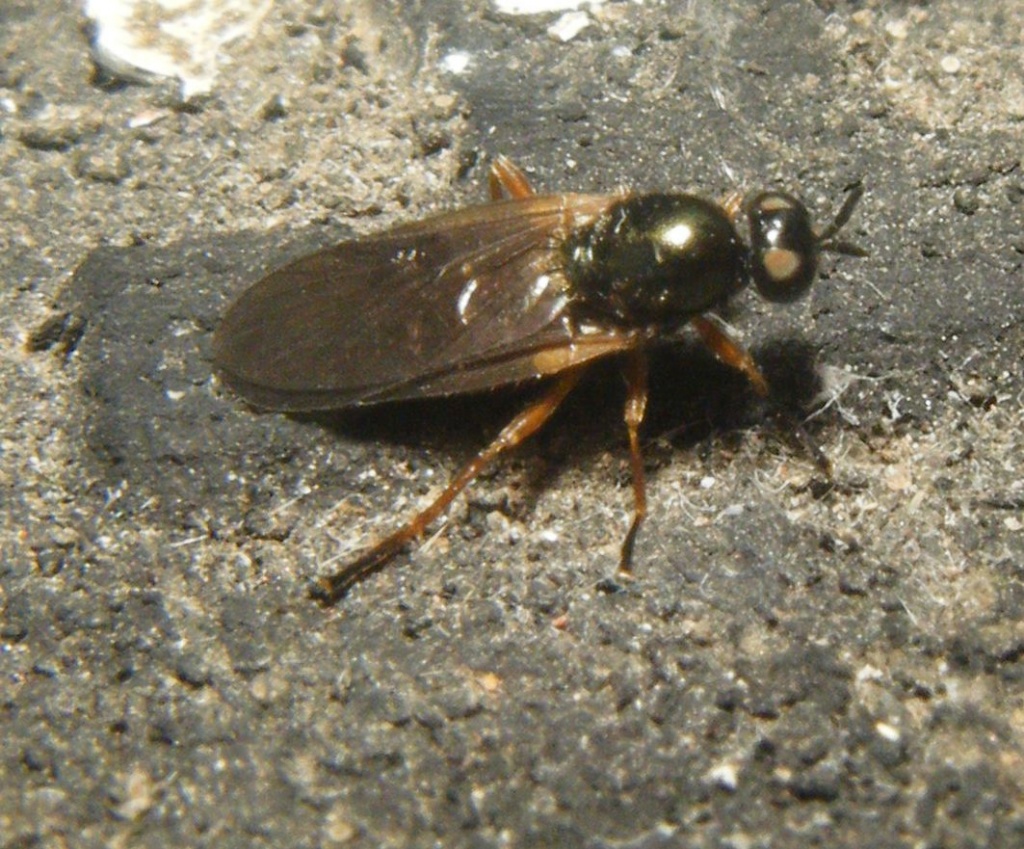
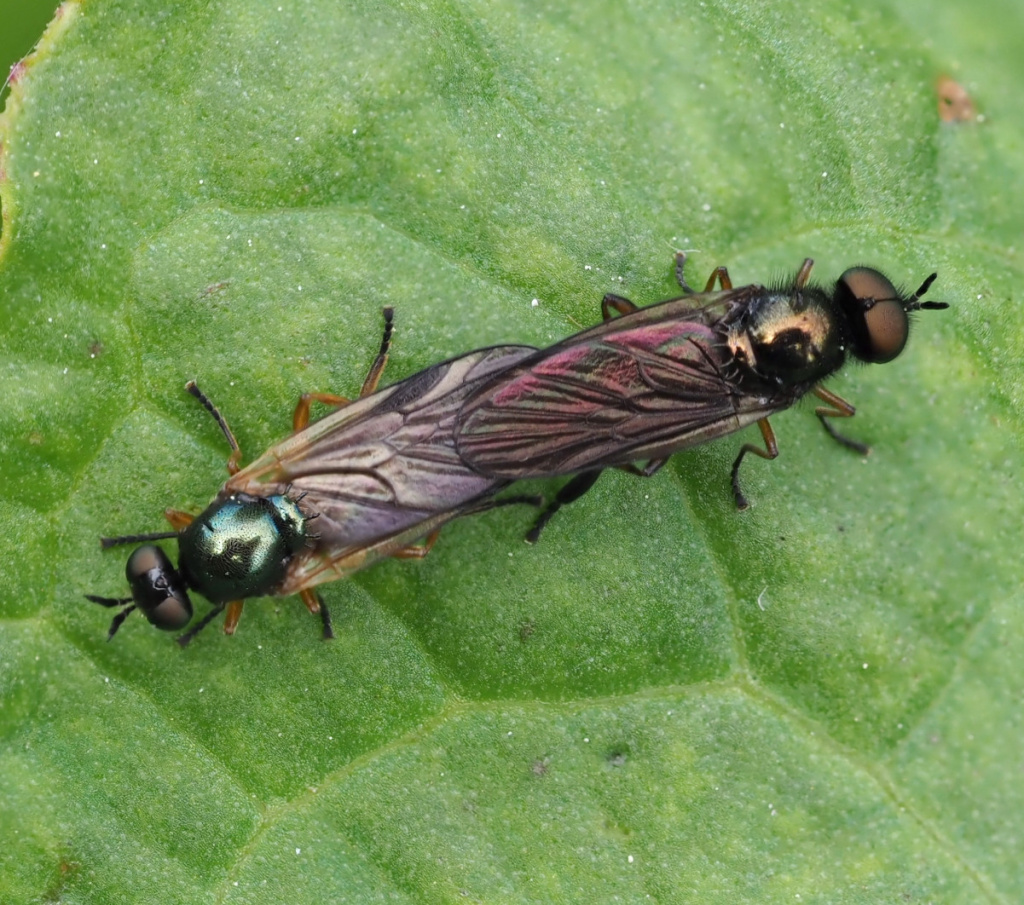
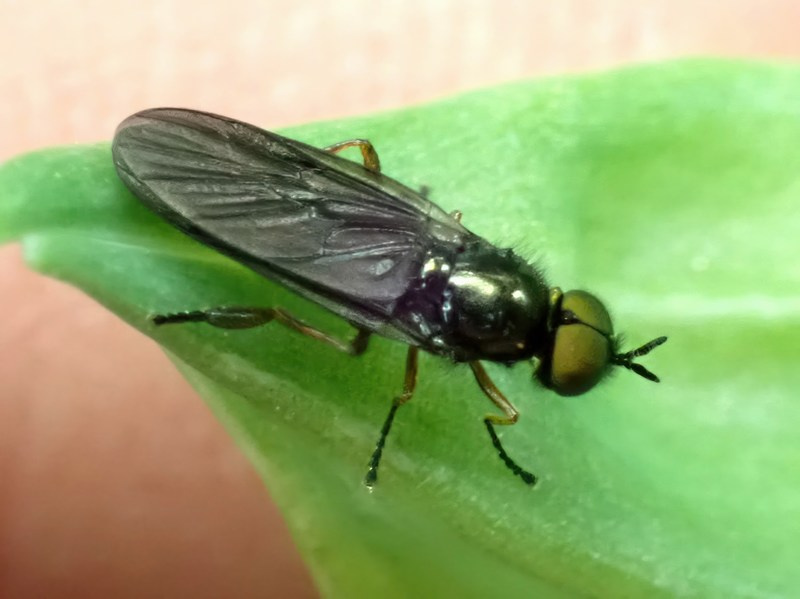
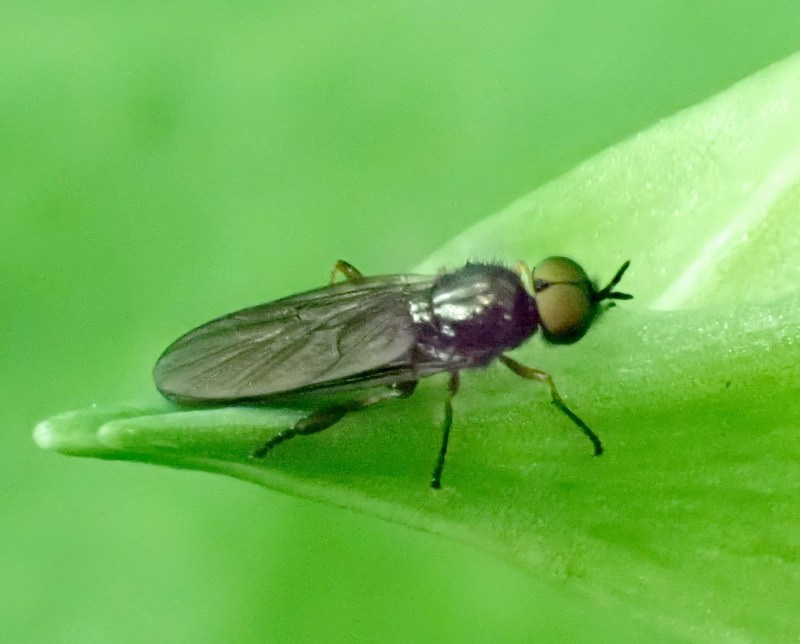
Murky-legged Black Legionnaire - Beris chalybata
5-6mm. Males and females are noticeably different.
Beris, as a genus, can generally be recognised by having 6 spines projecting from the scutellum (Four spines in Choriceps, however occasionally variants can have 5).
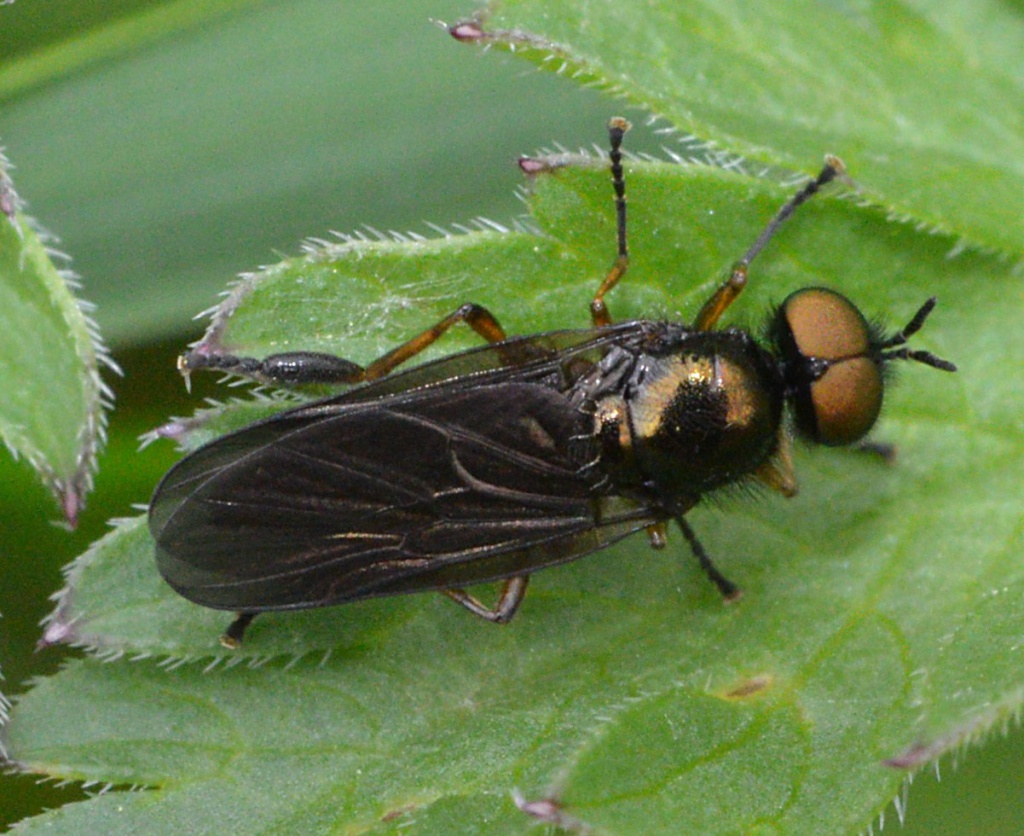
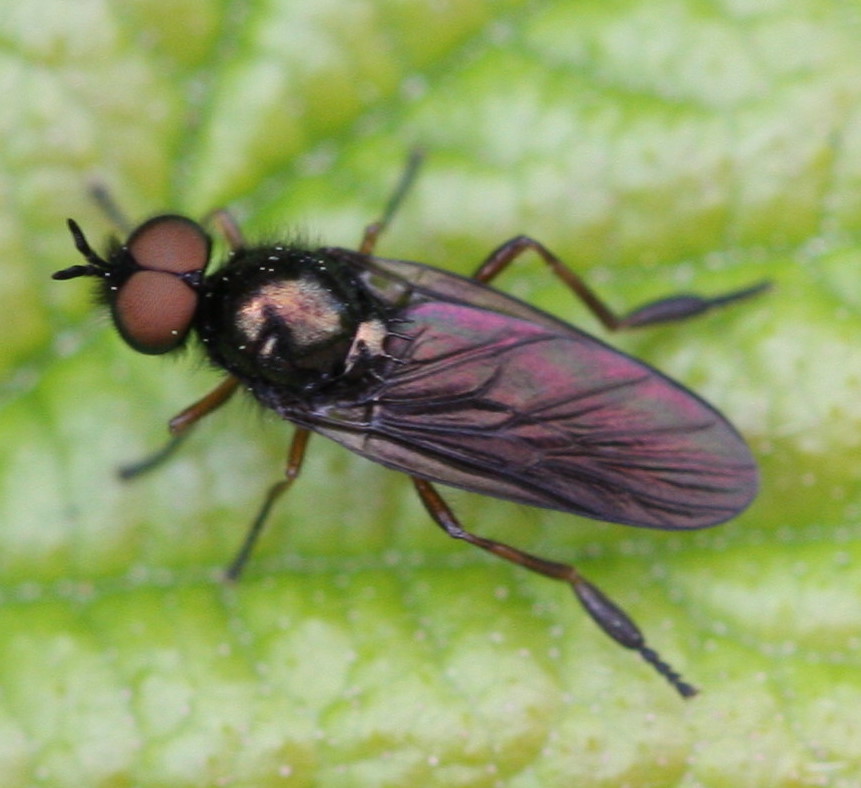
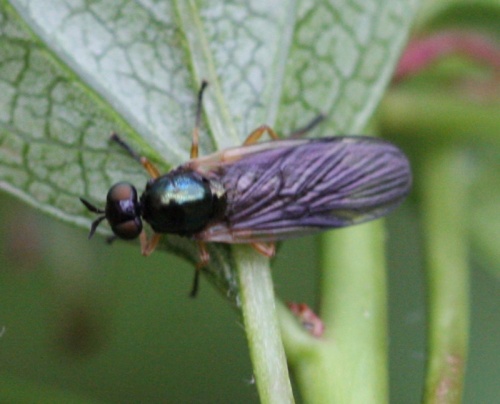
Males (eyes touching) have a dark green thorax, smoky wings and very hairy eyes. Males legs are dull yellow-brown but with dark tarsi and an inflated hind basitarsus.
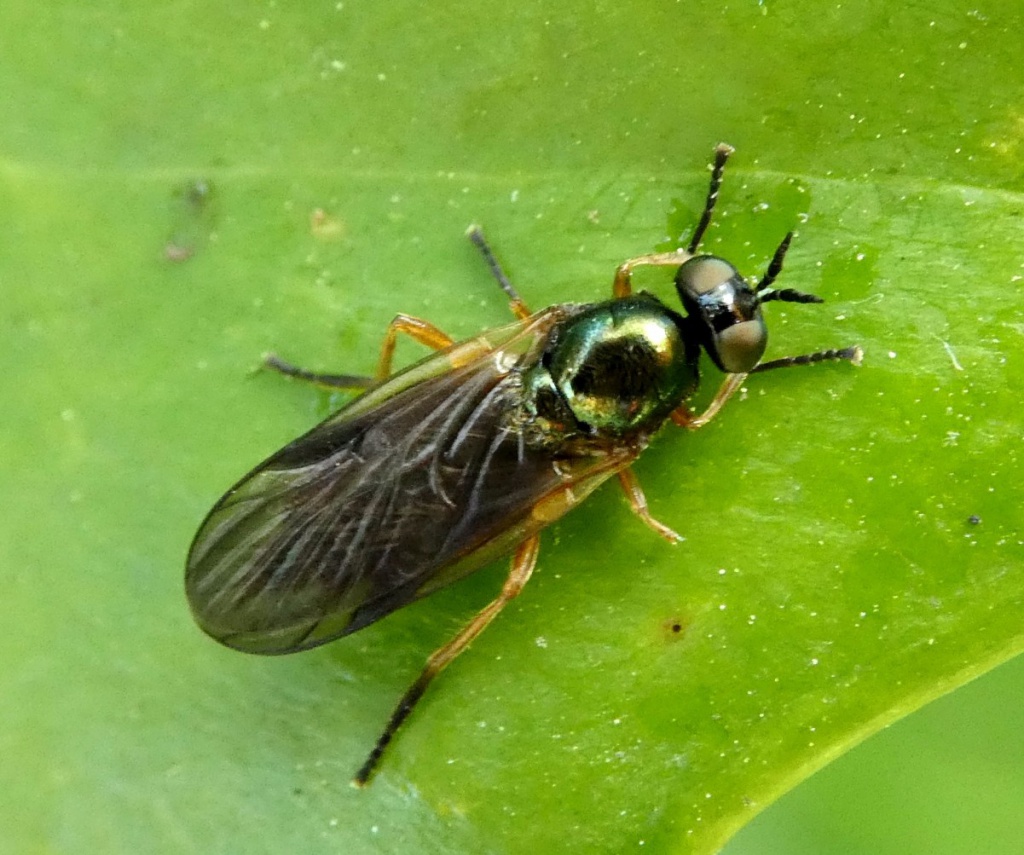
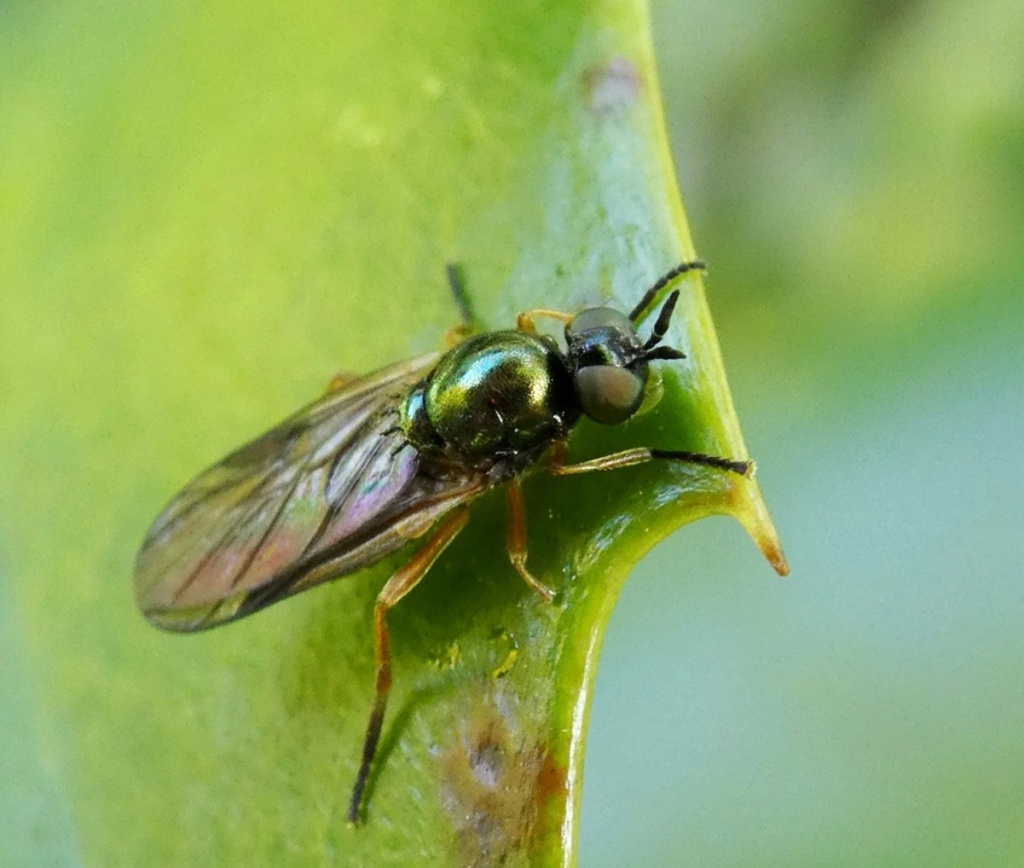
Females (eyes widely separated) have a brighter glossy green thorax and clearer wings with a black stigma. Their legs are generally yellow with dark tarsi.
There are 6 British species in the Beris genus and these can usually be distinguished by the combination of abdomen and leg colours. See ID Aids below.

This genus of soldierflies are all of modest size with an elliptical abdomen. The abdomen is either blackish or mainly orange but without a striking pattern. They also have 6 spines projecting backwards from the scutellum. Note that flies in the related Chorisops genus have 4 spines.
There are 6 known species in Britain. It is not known if all can be found in Leicestershire and Rutland and the status descriptions are based on national records.
| Species | Abdomen | Legs | Status |
| B. chalybata | black | dull orange | common |
| B. fuscipes | black | dark with orange on tips of femora + base of tibiae | uncommon |
| B. geniculata | black | dark all over | common |
| B. morrisii | black | clear yellow | uncommon |
| B. clavipes | orange | hind tibiae orange | rare |
| B. vallata | orange | hind tibiae half black / half orange | common |
Note: as with many species there can be variation amongst specimens.
Unless identified by a recognised expert, a photo is required. If the photo doesn't show the key ID features then in the comments box describe the size and identifying characters you have observed.
Flying, or resting, on sunlit leaves in bushes, hedges or other flowering plants.
Early summer.
It feeds on pollen and nectar and sometimes also on the substrate of rotten plants. Females lay eggs individually on rotting plants. The larvae overwinter. They pupate in spring, in a hardened larval skin. The adult flies leave this through a T-shaped slit.
Fairly frequent and widespread in Britain.
Fairly common in Leicestershire and Rutland
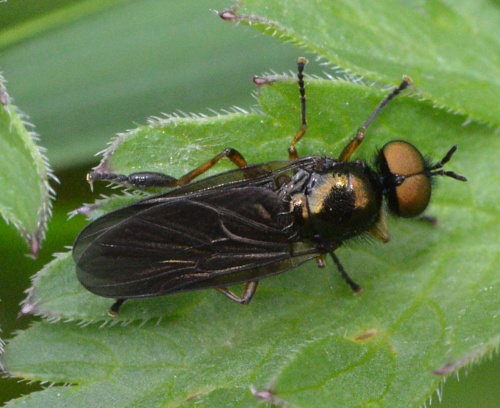 Barbara Cooper
Long Clawson
04 May 2022
male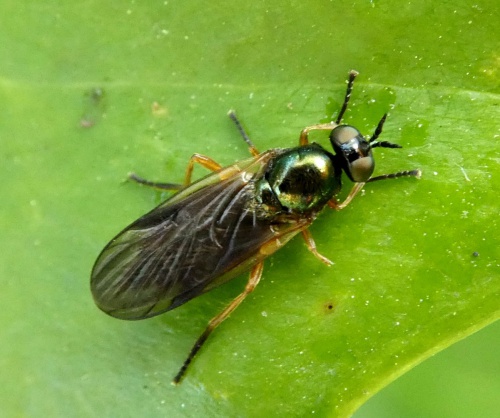 Kate Nightingale
Cropston garden
10 May 2017
female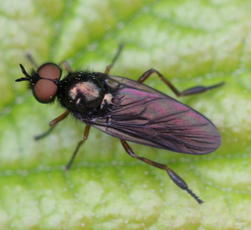 David Nicholls
Watermead Country Park
15 May 2010
male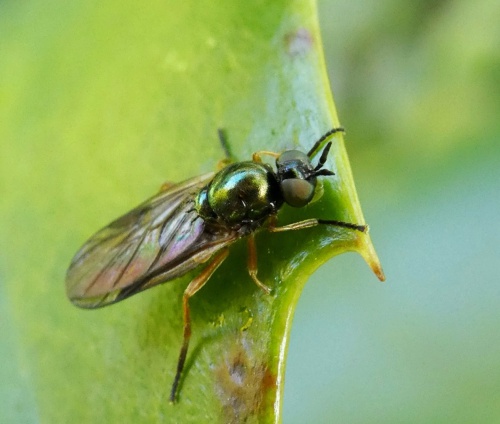 Kate Nightingale
Cropston garden
10 May 2017
Leicestershire & Rutland Map
Enter a town or village to see local records
MAP KEY:
Yellow squares = NBN records (all known data)
Coloured circles = NatureSpot records: 2025+ | 2020-2024 | pre-2020
UK Map
Species profile
- Common names
- Murky-legged Black Legionnaire
- Species group:
- insect - true fly (Diptera)
- Kingdom:
- Animalia
- Order:
- Diptera
- Family:
- Stratiomyidae
- Records on NatureSpot:
- 43
- First record:
- 15/05/2010 (Nicholls, David)
- Last record:
- 26/05/2025 (Nicholls, David)
Total records by month
% of records within its species group
10km squares with records
The latest images and records displayed below include those awaiting verification checks so we cannot guarantee that every identification is correct. Once accepted, the record displays a green tick.
In the Latest Records section, click on the header to sort A-Z, and again to sort Z-A. Use the header boxes to filter the list.
Latest images
Latest records
 David Nicholls
20 Acre Piece
11 May 2012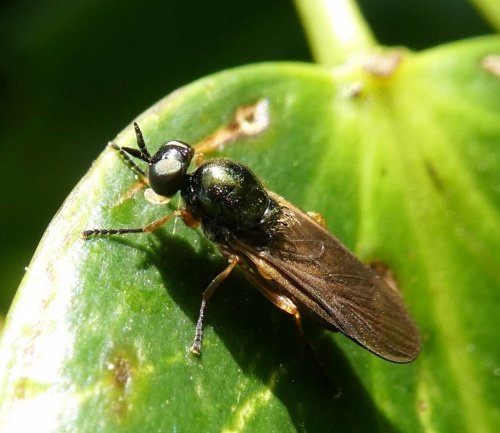 Kate Nightingale
Cropston garden
10 May 2017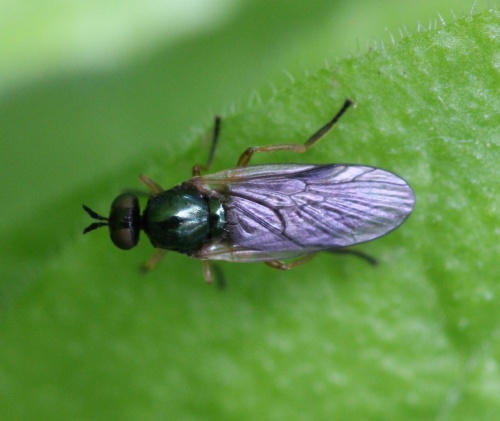 David Nicholls
Sheet Hedges Wood
02 May 2014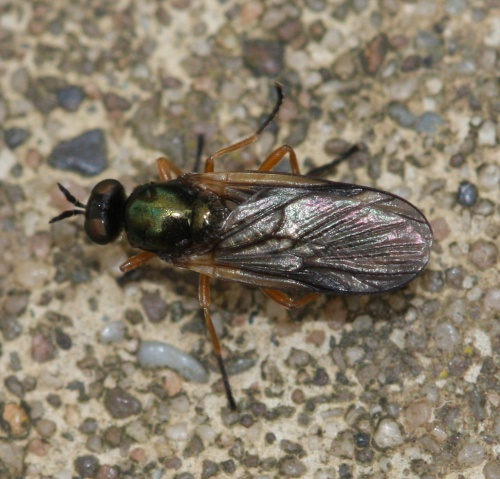 David Nicholls
Aylestone Meadows
18 May 2013
female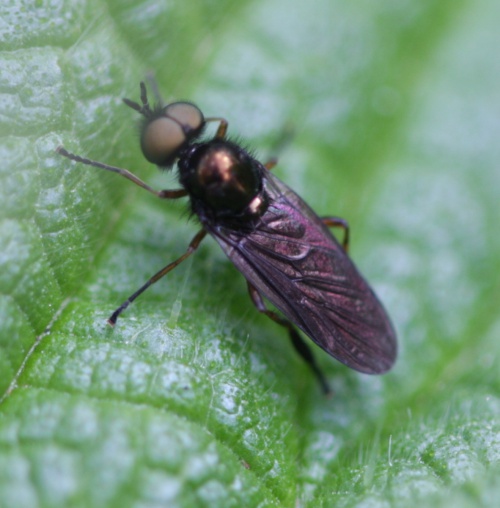 David Nicholls
Watermead Country Park
01 May 2015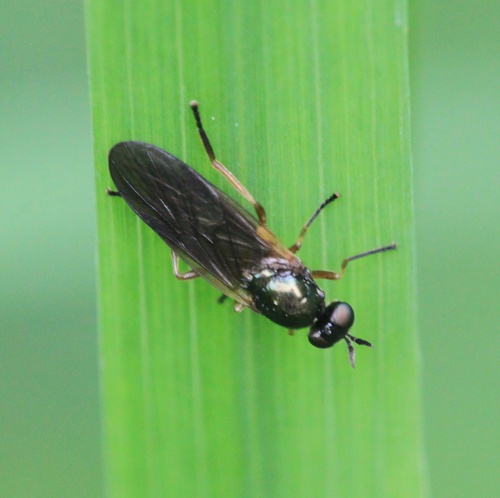 Paul Ruddoch
Melton Country Park
04 June 2016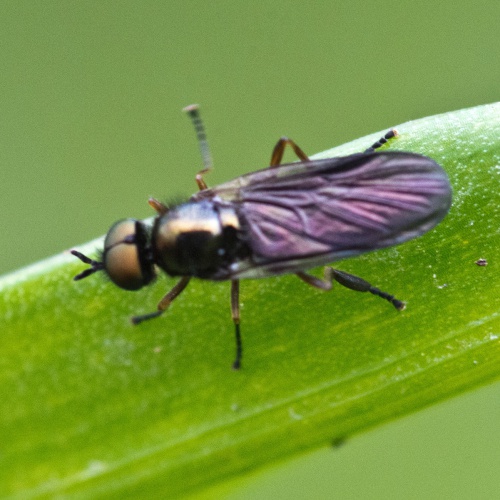 AJ Cann
Prior's Coppice
29 April 2017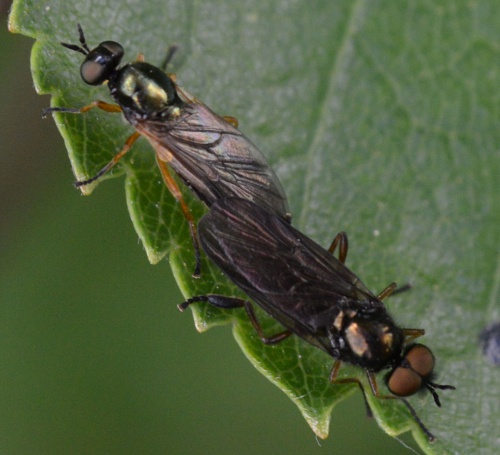 Barbara Cooper
Long Clawson
09 May 2018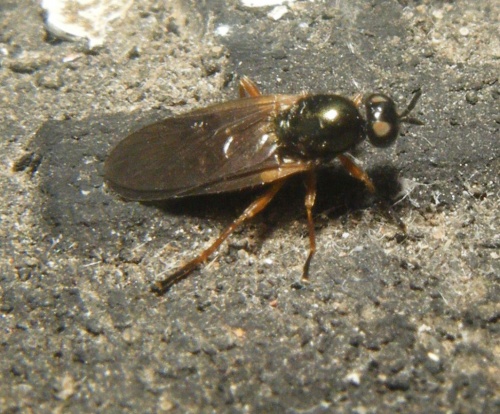 Graham Calow
Sapcote
26 May 2012
female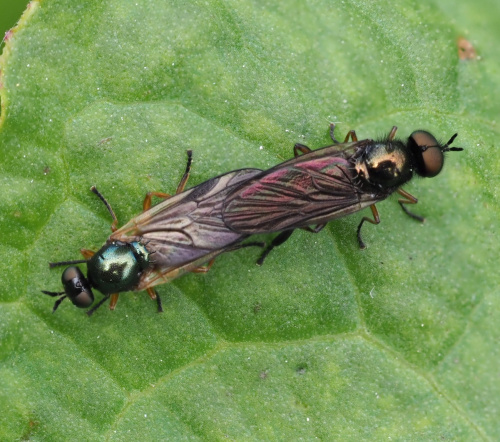 David Nicholls
Kelham Bridge NR
08 May 2024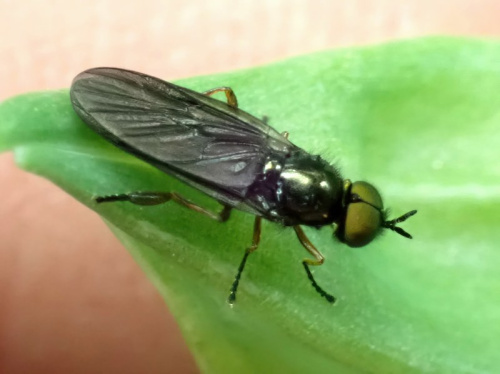 Ian Harding
Sheet Hedges Wood
21 April 2024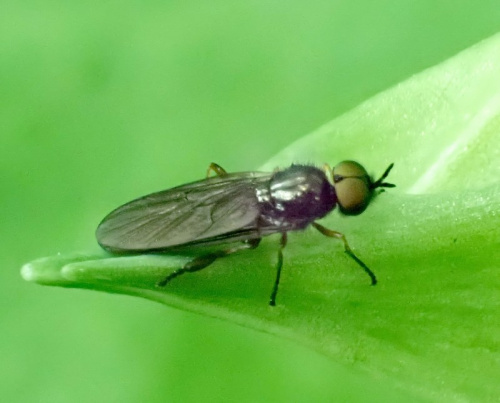 Ian Harding
Sheet Hedges Wood
21 April 2024