

Little Emerald - Jodis lactearia
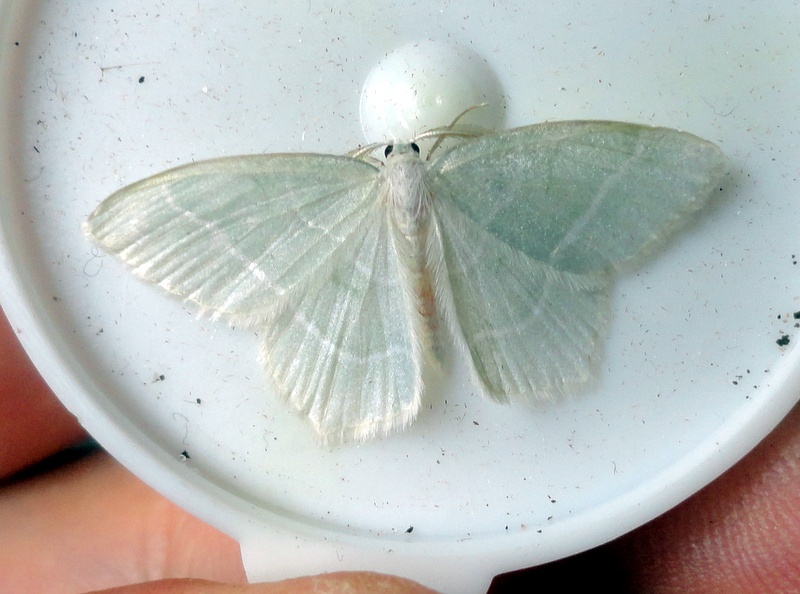
Wingspan 23 to 26 mm. A paler green than most other 'emeralds', the colour fades very quickly after the moth's emergence from the pupa.

Occurring in woodland areas.
Flies in May and June.
Feeding on a range of trees and bushes, including Birch, Hawthorn and Oak, the larva pupates before overwintering.
It is fairly common throughout England, Wales and Ireland. In a recent survey to determine the status of all macro moths in Britain this species was classified as common.
Fairly frequent but not common in Leicestershire and Rutland. L&R Moth Group status = B (scarce resident or restricted distribution or regular migrant).
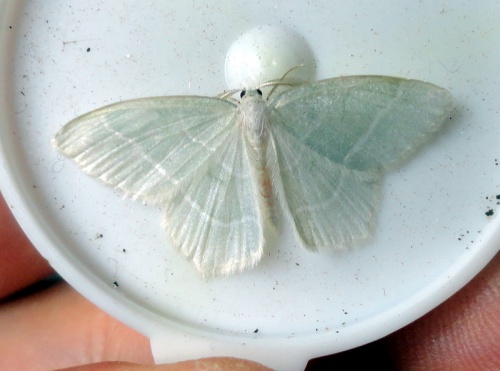 andrew johnson
Dadlington garden
09 June 2014
Leicestershire & Rutland Map
Enter a town or village to see local records
MAP KEY:
Yellow squares = NBN records (all known data)
Coloured circles = NatureSpot records: 2025+ | 2020-2024 | pre-2020
UK Map
Species profile
- Common names
- Little Emerald
- Species group:
- insect - moth
- Kingdom:
- Animalia
- Order:
- Lepidoptera
- Family:
- Geometridae
- Records on NatureSpot:
- 2
- First record:
- 09/06/2014 (Johnson, Andrew)
- Last record:
- 21/06/2022 (Cranston, Elspeth)
Total records by month
% of records within its species group
10km squares with records
The latest images and records displayed below include those awaiting verification checks so we cannot guarantee that every identification is correct. Once accepted, the record displays a green tick.
In the Latest Records section, click on the header to sort A-Z, and again to sort Z-A. Use the header boxes to filter the list.