

Bolete Mould - Hypomyces chrysospermus
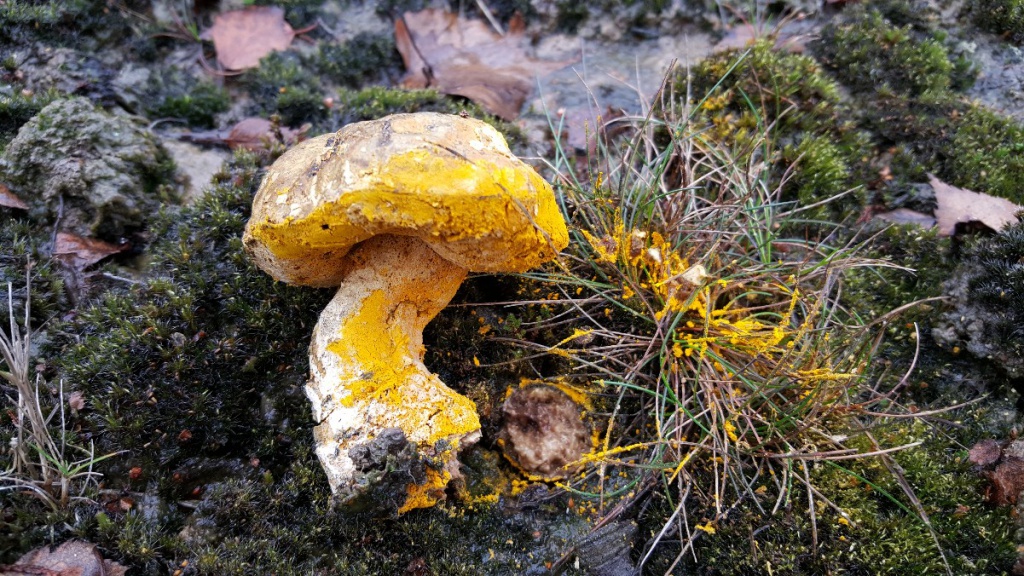
The Bolete Mould is parasitic on various species of bolete, eventually covering the whole fruitbody. Initially it is white, becoming pale yellow and then golden yellow. This is the asexual state, producing large powdery 'aleuriospores', and it is most often recorded in this state. The sexual state, producing olive-green perithecia, is rarely recorded.
Hypomyces microspermus also attacks Boletes and is identical in the field - but only attacks the Xerocomelloid type such as Red Cracking Bolete; these have dry caps, often velvety in texture and often cracking into a mosaic pattern. As Hypomyces chrysospermus also attacks Xerocomelloid boletes, mould found on these boletes must be microscopically examined. Other Hypomyces species may also attack boletes.
non-Xerocomelloid  Xerocomelloid /microscopy
Photograph the mould on the host bolete; if possible, identify the genus of bolete and note this in your comments. If the bolete is not identifed or is an Xerocomelloid species (e.g Red Cracking bolete) microscopic examination is needed.
On Bolete mushrooms.
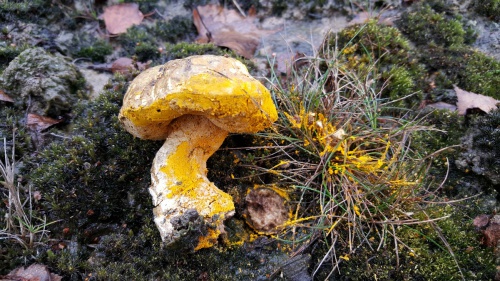 Ben Devine
Newfields
19 November 2015
yellow fungal infection on bolete
Leicestershire & Rutland Map
Enter a town or village to see local records
MAP KEY:
Yellow squares = NBN records (all known data)
Coloured circles = NatureSpot records: 2025+ | 2020-2024 | pre-2020
UK Map
Species profile
- Common names
- Bolete Mould
- Species group:
- fungus
- Kingdom:
- Fungi
- Order:
- Hypocreales
- Family:
- Hypocreaceae
- Records on NatureSpot:
- 18
- First record:
- 19/11/2015 (Devine, Ben)
- Last record:
- 17/10/2025 (Alton, John)
Total records by month
% of records within its species group
10km squares with records
The latest images and records displayed below include those awaiting verification checks so we cannot guarantee that every identification is correct. Once accepted, the record displays a green tick.
In the Latest Records section, click on the header to sort A-Z, and again to sort Z-A. Use the header boxes to filter the list.