

Common Comfrey agg. - Symphytum officinale
Stout plant to 1.2 metres. Stems erect, widely winged. Leaves large and coarse, untoothed, strongly decurrent (the base running on to the stem), only the lowest stalked. Flowers, pink, whitish or purple-violet 12 to 18 mm bell shaped with reflexed lobes, borne in forked clusters. Because Comfrey hybridizes freely and is so difficult to identify with certainty we have decided to treat Common Comfrey as an aggregate. There are few national experts who have the necessary expertise to arrive at a precise identification with any degree of certainty.
Many other species, hybrids and varieties of comfrey with blue, pink or pale flowers - especially Russian Comfrey and Hidcote Comfrey, for which it is often recorded in error.

The true species has strongly decurrent leaves - i.e wings from each leaf extend down the stem beyond the leaf below (more than 1 internode). Hybrids often have decurrent leaves, but moderately or weakly so. The true species also has smooth, shining nutlets. Flower colour is variable, but rarely white or blue; cream, purplish or striped light and dark purple.
This can't be verified from the flowers alone; a photograph of the whole plant, including leaves and stems.
Damp grassland, roadside verges and banks of streams.
May to July.
Perennial.
Found throughout Britain but scarcer in the North.
Fairly frequent in Leicestershire and Rutland. In the 1979 Flora survey of Leicestershire it was found in 80 of the 617 tetrads.
Leicestershire & Rutland Map
Enter a town or village to see local records
MAP KEY:
Yellow squares = NBN records (all known data)
Coloured circles = NatureSpot records: 2025+ | 2020-2024 | pre-2020
UK Map
The latest images and records displayed below include those awaiting verification checks so we cannot guarantee that every identification is correct. Once accepted, the record displays a green tick.
In the Latest Records section, click on the header to sort A-Z, and again to sort Z-A. Use the header boxes to filter the list.
Latest images
Latest records
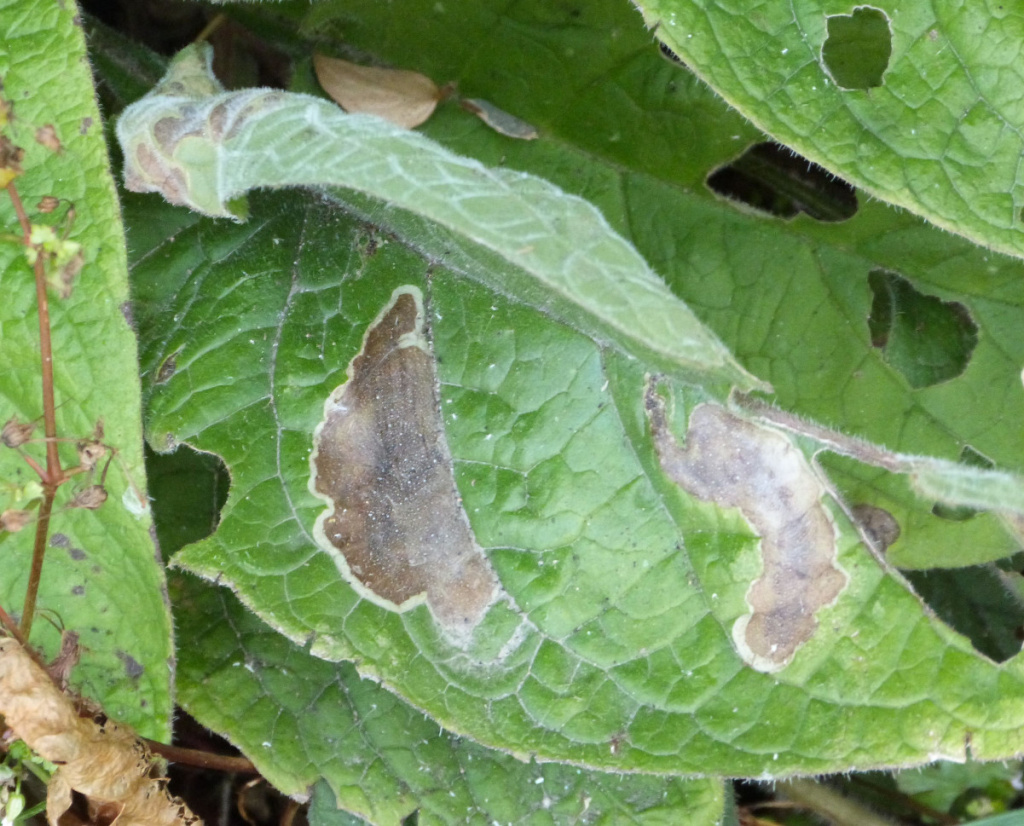
Agromyza abiens/myosotidis/lithospermi agg.
The larvae of the Agromyzid flies Agromyza abiens, Agromyza myosotidis and Agromyza lithospermi produce identical mines on the leaves of several food plants in the Boraginaeceae family, such as Borage, Comfrey and Green Alkanet plus a number of other host plants. The initial narrow gallery contains frass in a double line, which it then expands to form a blotch mine. Several larvae may occupy a leaf to form a large blotch. Because the mines on these plants cannot be reliably separated to species level we treat them as an aggregate.