

Dichrorampha aeratana
Obscure Drill
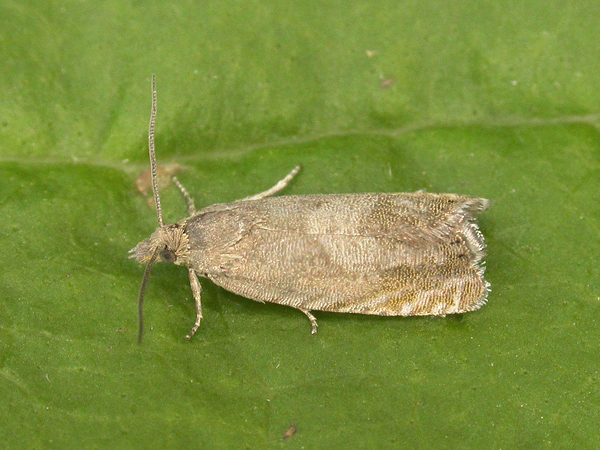
Wingspan about 14mm. Several of the Dichrorampha species are very alike in outward appearance, and it is often necessary, as with the present species, to examine the genitalia to be sure of identification.

Various habitats, especially near to flower meadows and rough grassland.
Adult moths fly in May and June.
The larva feeds internally in the rootstock of Oxeye Daisy.
In particular confusion of this species with D. plumbana has led to uncertainty to its exact distribution. It is more frequent in parts of southern England, while having been recorded northwards to Scotland, and in Ireland. In the Butterfly Conservation's Microlepidoptera Report 2011 this species was classified as local.
It appears to be uncommon in Leicestershire and Rutland, where there are few records. L&R Moth Group status = D (rare or rarely recorded).
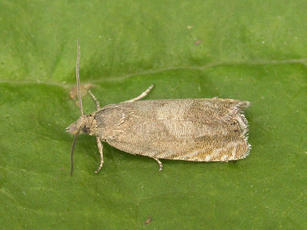 Mark Skevington
Huncote Embankment
13 June 2011
Confirmed by Gen. Det.
Leicestershire & Rutland Map
Enter a town or village to see local records
MAP KEY:
Yellow squares = NBN records (all known data)
Coloured circles = NatureSpot records: 2025+ | 2020-2024 | pre-2020
UK Map
Species profile
- Common names
- Obscure Drill, Dingy Daisy Moth
- Species group:
- insect - moth
- Kingdom:
- Animalia
- Order:
- Lepidoptera
- Family:
- Tortricidae
- Records on NatureSpot:
- 2
- First record:
- 11/06/2003 (Skevington, Mark)
- Last record:
- 13/06/2011 (Skevington, Mark)
Total records by month
% of records within its species group
10km squares with records
The latest images and records displayed below include those awaiting verification checks so we cannot guarantee that every identification is correct. Once accepted, the record displays a green tick.
In the Latest Records section, click on the header to sort A-Z, and again to sort Z-A. Use the header boxes to filter the list.