

Epinotia abbreviana
Brown Elm Bell
Wingspan 12 to 16 mm. E. abbreviana varies greatly in the strength of its markings and darkness of colour.

Wherever Elms occur on lowland sites. During daylight, it often sits exposed on foliage or trunks.
It flies in June and July at dusk and night
In April, the early instar larva eats through an Elm bud. When the bud opens it reveals a highly distinctive arc of holes caused by the larva but by this time the larva has moved to a spinning made with another Elm leaf. Pupation occurs in late May or early June. Field Maple is also eaten.
Fairly frequent throughout the British Isles. In the Butterfly Conservation’s Microlepidoptera Report 2011 this species was classified as common.
Occasional in Leicestershire and Rutland. L&R Moth Group status = C (very scarce resident or rare migrant)
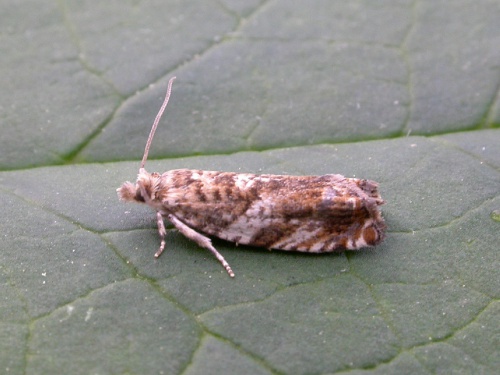 Adrian Russell
Park Wood, Stockerston
22 June 2014 Harecroft Crescent Sapcote SP49019371 (taken 22.6.2010)..JPG) Graham Calow
Graham Calow
Sapcote garden1
22 June 2010
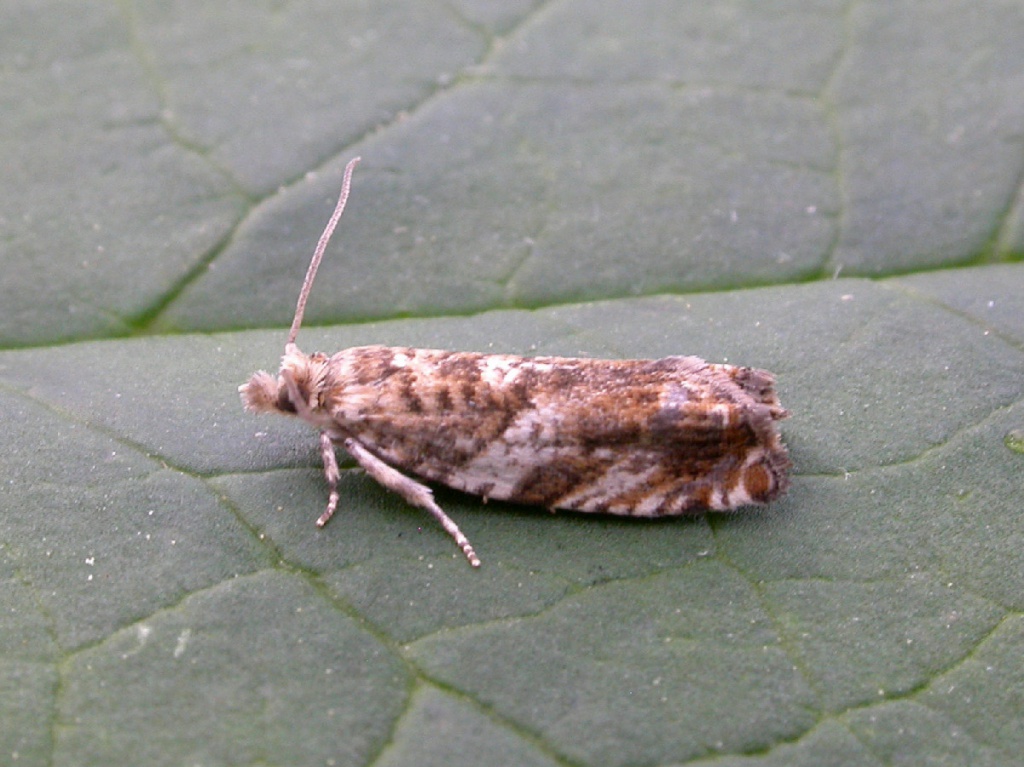
 Harecroft Crescent Sapcote SP49019371 (taken 22.6.2010)..JPG)
Leicestershire & Rutland Map
Enter a town or village to see local records
MAP KEY:
Yellow squares = NBN records (all known data)
Coloured circles = NatureSpot records: 2025+ | 2020-2024 | pre-2020
UK Map
Species profile
- Common names
- Brown Elm Tortrix, Brown Elm Bell
- Species group:
- insect - moth
- Kingdom:
- Animalia
- Order:
- Lepidoptera
- Family:
- Tortricidae
- Records on NatureSpot:
- 19
- First record:
- 22/06/2010 (Calow, Graham)
- Last record:
- 24/06/2024 (Poole, Adam)
Total records by month
% of records within its species group
10km squares with records
The latest images and records displayed below include those awaiting verification checks so we cannot guarantee that every identification is correct. Once accepted, the record displays a green tick.
In the Latest Records section, click on the header to sort A-Z, and again to sort Z-A. Use the header boxes to filter the list.