


These guides are designed to help you identify and record the most common and easily recognised species in each of the featured wildlife groups. You are not restricted to these species but hopefully they will provide a useful starting point.
Each species is illustrated with a representative photo together with a few key tips on where to find it, how to identify it and whether there are any other species that look similar. The red/amber/green ID ratings indicate how easy, or difficult, that species is to identify. Some of the species in each guide are suggested as target species as we think they should be possible for everyone to find and positively identify.
If you find a species not included on these sheets try looking at the NatureSpot galleries for that group. You can also post an image on the NatureSpot forum and hopefully one of our members will try to help you.
Photos are key so wherever possible take one - or even better several from different angles! The 'Recording' section on the guides gives some guidance on whether a photo is necessary to accompany your record and what to do if you haven't got one.
You can download and print the guides if you wish but the links in the documents will of course only work when viewing them online
Mammals & Birds
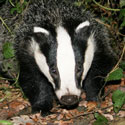 |
Most mammals are hard to see, most being either shy or nocturnal - or both. Recording mammals therefore is often about recognising their tracks and signs - which are much easier to find than the live animals themselves. Examples include mole hills, fox prints, badger hair, etc. Another way to record mammals is from road casualties. Do submit a photo with your record if you can, especially for tracks and signs. |
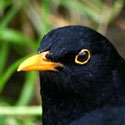 |
Over 300 bird species have been recorded in Leicestershire. Many species of bird visit gardens, especially if there are feeders and shrubs/trees to provide cover but we have selected the 10 most commonly found. Seed, peanut and fat feeders will help you attract more birds and bring them nearer to view. Birds can be hard to photograph so if you can't get an image, just briefly describe the bird in the comments box. |
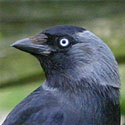 |
These birds are some of the species most commonly encountered when out in the countryside. All the birds shown below, except the Swallow, are resident and can be found all year, but many more species migrate here in the summer and others just for the winter. See the Garden Birds ID guide for more common bird species. |
Insects
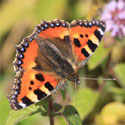 |
Butterflies, along with moths, are in the insect order Lepidoptera, which means ‘scaly wing’ and refers to the microscopic scales that bring the colour and patterns we see. There are around 60 UK species and about half of these can be found in Leicestershire. Some overwinter as adults and can emerge as early as January/February. The adults feed on nectar so visit flowers, whereas caterpillars eat the leaves of specific plants. You can record the species from a caterpillar if you can identify it. A photo should be submitted with your record where possible, otherwise add a brief description to the comments box. |
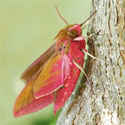 |
There are many more moth species than butterflies but many are nocturnal to hard to find without using a light trap. The species in this guide are either day-flying or common species that are often disturbed during the day so much more likely to be encountered. For some species, caterpillars are easier to find than the adults and it is fine to record them from a caterpillar sighting, providing you can identify the species. Many moth caterpillars require a particular plant species to feed on so knowing this makes it easier to both find and identify them. |
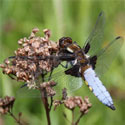 |
Dragonflies and damselflies make up the insect order Odonata. Dragonflies are generally larger and rest with their wings spread. Damselflies usually rest with their wings closed. Both are fearsome aerial predators, able to catch prey on the wing. Both groups start life in water where their larvae normally spend 1-3 years feeding and growing before climbing up vegetation to transform into the spectacular adults. They have an ancient evolutionary lineage, being some of the first creatures to develop flight. Most adults can be best found near to water but a few travel further afield. |
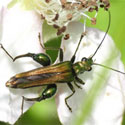 |
Beetles are one of the most diverse animal groups around with over 2000 species in Leicestershire alone. Most can fly but hide their wings under hard wing cases. They can be found in almost every habitat, including houses, water and inside wood and fungi. Locally they range in size from 1mm to 30mm. Many beetle species look very similar and need detailed examination to identify, but those in this guide are common and relatively easy to identify. |
 |
Though the term 'bugs' is used loosely to describe many small invertebrates, it really refers to insects in the order Hemiptera. True bugs come in a fascinating range of shapes, colours and sizes, including Shieldbugs, Assassin Bugs, Damselbugs, Leafhoppers, Aphids and more. They all have mouthparts like a hypodermic needle, used mainly for feeding on plants. A few are predatory and feed on other insects. They are predominently found on plants and in summer are incredibly numerous. Because many feed on one or a few types of plants, it is useful to note which plant when recording bugs. |
 |
Flies represent the largest insect group and as we all know are found everywhere. The dizzying variety can make it difficult to identify many species but some are relatively easy to recognise and this guide features some of these. Flies are in the insect order Diptera, which means two wings (unlike most other insects which have four). The hind wings have evolved into 'halteres' - small drumstick like protuberances which are sensory organs to aid balance and maneuverability. Many adults feed on nectar so can be found on flowers, others are predatory, sometimes waiting on flowers to catch their next meal. |
 |
Hoverflies are a family of flies in the Syrphidae family. As the name suggests, they frequently hover whilst visiting flowers or in the case of males, defending a territory. Many, though not all species, have a yellow and black colour pattern in order to mimic bees and wasps. Whilst they are totally harmless, by resembling insects that can sting they hope to put off predators. Hoverflies, like all flies, only have one pair of wings so can be distinguished from bees and wasps which have two pairs. They feed on nectar and pollen so can be most easily seen visiting flowers. |
Other invertebrates
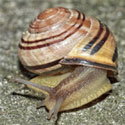 |
Land snails evolved from their marine ancestors, helped by a shell that only offers protection from predators but also serves to reduce dehydration. Nevertheless, most snails are vulnerable to water loss and tend to be nocturnal when it is cooler and/or emerge in wet conditions. Some can cope with hotter weather by sealing themselves into the shell with mucus that dries like skin across the shell mouth. Most snails can be identified from the shell alone so it is worth photographing empty shells - flood debris is a great place to look for these. Note the size in the comments box. |
 |
Slugs evolved from snails - they have lost their shells to make movement easier. They can burrow in soil or squeeze into tight spaces without the encumbrance of a shell! Only a few slug species are garden pests and these unfortunately give them all a bad name. Most species eat dead organic material and so play an important recycling role. When recording slugs try to take a photo of the right hand side as this shows the breathing hole. An image from above and another of the sole are also helpful. Add a comment as to the size when submitting your slug records. |
Wildflowers, grasses, trees and fungi
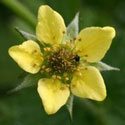 |
Most people dismiss ‘weeds’ as unimportant and annoying plants that must be removed. But look afresh at these species and instead recognise them as wildflowers that are superbly adapted to colonise ‘new’ habitats. Many have super-charged life-cycles, growing and setting seed quickly and often able to thrive in places with hardly any soil. Others have a different life strategy – to spread vegetatively and try to dominate an area and prevent the competition finding room or light. You have to admire them! Only record plants in gardens that have arrived naturally and not been planted or spread. |
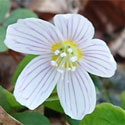 |
Woodlands can be a difficult place for wildflowers. The shade cast by trees makes it hard for ground plants to get sufficient light. Many woodland wildflowers therefore flower early in the year before the trees come into leaf so March to early May are good times to visit. Other woodland wildflowers grow along rides and at the woodland edge where more dappled light is available. When recording any wildflowers, try to take photos from different angles showing flowers, seeds, basal leaves, stem leaves, etc. (not all are visible all of the time!). |
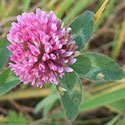 |
These 47 wildflowers are the most frequently recorded species from NatureSpot’s recent surveys of road verges in Leicestershire. They are grouped by flower families with a note of the features that are common to all species featured. The features described below the images should help you distinguish between the other species illustrated. However there may be other, less common, species that are not listed. A hand-lens is always useful to look at the small, but often important, details. To record these species on NatureSpot, please attach a photo. |
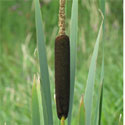 |
Common Grasses, Sedges, Rushes Grasses and their relatives, the rushes and sedges, are often over-looked as they are wind pollinated so lack colourful flowers to attract insects. Yet grasses are the dominant plants around us and play a vital role in the ecosystem, providing food and shelter for so many animals. If you pause to look more closely, grasses are fascinating and beautifully adapted to thrive in their habitats. These 10 species are all common and not difficult to identify. As with flowers, take photos of different parts of the grass, as well as the whole plant in its habitat. |
 |
|
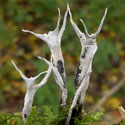 |
Fungi are neither plants nor animals but a Kingdom in their own right. There are thousands of species, many very similar, so identification can be challenging but those shown here are all common and reasonably easy to recognise. The mushrooms we see are only the ‘flowers’ – the reproductive bodies, the fungus itself is a network of threads embedded in the ground or host plant or animal. Fungi are hugely important recyclers, vital ‘partners’ for many trees and are key food and breeding sites for animals. |
 |
Lichens are all around us – on trees, rocks, walls and even under our feet on tarmac paths. Whilst many are tricky to identify, there are a number of common species that everyone can learn to recognise. They are a great group to look at in the winter months when there are few plants and insects around, indeed they are at their best at this time of year. Here are our Top 10 to get you started. Though small, they are relatively flat so not difficult to photograph. Look for a 'good' specimen, as worn and young lichens are more difficult to identify. |
.
